

The first thing I do when I walk into my kitchen at 6:20 in the morning is put the back of my hand against the side of the carafe. Warm means the Cuisinart did its job at 6:15 and I did not have to think about it. Cold means I forgot to press the button the night before. That has happened twice in two years, and both times it was my fault, not the machine's.
I bought the Cuisinart Brew Central about two years ago with my own money, off Amazon, and it replaced a plain drip machine with no timer that had been sitting on my counter for roughly eight years. I spent twenty-six years running a school cafeteria, which means I have made coffee for several hundred people at a time and I have opinions about kitchen equipment that come from scrubbing it rather than from reading about it. Now I cook for two. Gary and I drink about six cups between us most mornings, and the machine lives on the counter by the sink where I can reach the carafe without moving my feet.
The Quick Verdict
A programmable drip machine that has done the one thing I asked of it for two years straight: coffee ready at 6:15 without me standing there. It is deep on the counter, and a twelve-cup carafe is more pot than two people need on a weekday, but I have never once wished I had bought something else.
Amazon Check Today's Price →Coffee at 6:15 Without Standing at the Counter
I set it after dinner and walk away. Two years of mornings says the timer holds, and the low heat setting keeps the second cup drinkable.
Amazon Check Today's Price on Amazon →How I've Used It
The routine has not changed in two years. After dinner, while Gary does the dishes, I fill the reservoir, scoop coffee into the permanent gold-tone filter with the measuring spoon that came in the box, and set the timer. Then I press the button and walk away. That is the whole ritual, ninety seconds at most. At 6:15 the next morning it has finished brewing, and by 6:20 I am holding a cup.
I should say up front that this is not a fancy machine and I did not want one. What I wanted was a pot of coffee waiting for me at a set hour, a carafe that pours without leaving a puddle on the counter, and something I could clean without taking it apart on the floor. The Brew Central does all three. The dripless spout has held up its end of the bargain, and the knuckle guard on the handle means I am not wrapping bare fingers around hot glass at six in the morning when I am not fully awake.
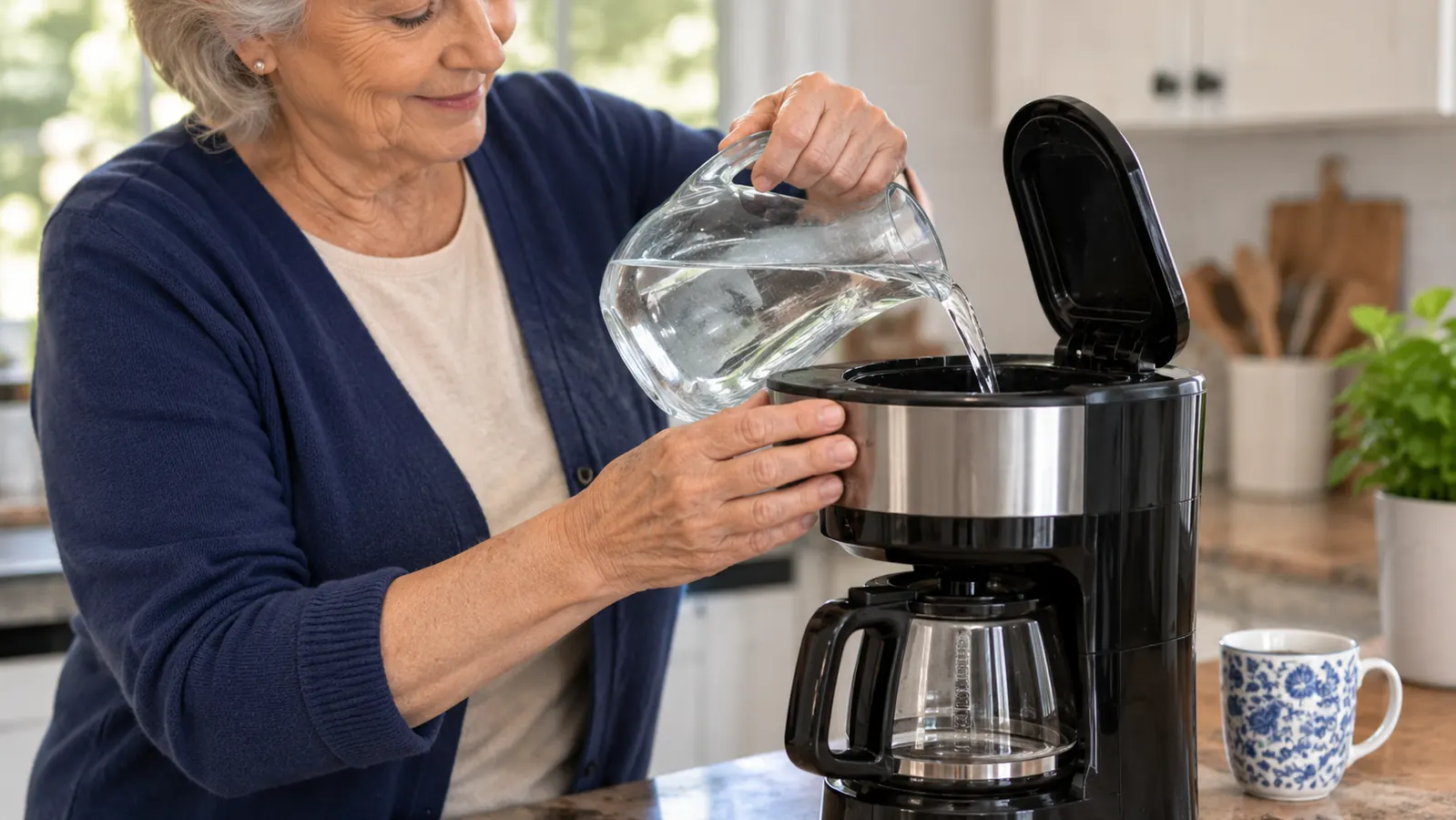
Filling it is straightforward. The reservoir is at the back and I fill it from a pitcher rather than trying to fit the whole machine under the tap, which I learned to do in the first week and have done ever since. I measure with the scoop that came in the box, one per cup and one for the pot, which is how I was taught in a cafeteria and how I still do it at home. Nothing about this machine needs a phone. You set the timer after dinner, you press the button, and the machine takes it from there.
Two years of daily use, plus Sunday mornings when the family is here and I brew a second pot for the crowd, and the machine still fills a full carafe in about the time it takes me to unload the dishwasher. Nothing has cracked, nothing has leaked, and the only part I have replaced is the charcoal water filter. I descale it about every two months, because New Hampshire water is what it is, and that is the extent of the maintenance.
The Timer Is the Whole Reason to Own It
If you take the programming away, this is an ordinary drip coffee maker, and I mean that as a compliment. The 24-hour programmability is the feature I actually paid for. I set it the night before, it brews at the hour I chose, and it shuts itself off afterward. The auto-off can be set anywhere from immediately to four hours. Mine is set short, because coffee that has been sitting on a warm plate for three hours tastes like the plate.
The heater plate has three settings, low, medium and high, and I keep it on low. On high the bottom of the pot picks up that scorched flavor that no amount of milk will fix. On low, a cup poured an hour after brewing still tastes like coffee. This is a small thing that turns out to matter every single morning, and it is the sort of adjustment most machines in this range do not give you.
There is also a 1-4 cup setting, which I use more than I expected. When Gary is at his brother's for the weekend, I do not want a full carafe. I want enough for two mugs and no leftover pot to pour down the sink. The small-batch setting is meant for exactly that, and the coffee does not come out thin the way a half pot usually does on a machine that only knows how to make twelve.
What Twelve Cups Actually Means in a House of Two
The carafe holds twelve cups and I have never once filled it to the top on a weekday. Six cups is our number, and six cups is what I brew. The capacity matters on the Sundays when both daughters and all four grandchildren are in the house, because then I make a full pot and a second one after that. Nobody waits in line for anything, and no one stands there feeding a single-serve machine one cup at a time while the toast goes cold.
The machine measures 15.59 inches deep, 11.8 inches wide and 9.61 inches tall, and it weighs a bit over four kilos. Those numbers matter in my kitchen because I have about eight feet of usable counter and every appliance competes for it. Depth is the number people forget. This one needs real counter depth, and on a shallow counter it will hang over the front edge. Mine sits beside the sink and I slide it rather than lifting it, because four kilos is more than I want to pick up at my age.
I will say plainly that on a narrow counter this is a lot of machine for two people. If you have a galley kitchen with twelve inches of usable depth, measure before you buy. Mine sits beside the sink with a couple of inches to spare, and I gave up the spot where the bread box used to live to make it fit. That was a trade I was willing to make for coffee that is ready when I get up. Someone with less counter would have to think harder about it than I did.
The Filters, and the Small Bother of Maintenance
The Brew Central comes with a permanent gold-tone filter, a number four paper coffee starter kit, a charcoal water filter, the carafe and a measuring spoon. I use the gold-tone filter almost all the time. It rinses clean in the sink, it has not torn, and it means I am not buying paper cones every month. When I want a cleaner cup on a Sunday I line it with a paper filter, which is what the starter kit is for, and the paper catches the fine sediment the permanent filter lets through. That is a preference, not a defect.
The basket lifts out for rinsing, which matters more than it sounds. Twenty-six years in a cafeteria teaches you fast that the part you cannot get to is the part that turns sour. This one comes out, rinses under the tap and goes back in, and I have never had to go at it with a brush. The carafe gets a rinse and a wipe after breakfast, and once a week I wash both with dish soap and let them dry on the rack.
The charcoal water filter sits in the reservoir and it does make a difference. I swap it when the coffee starts tasting flat, which with our water works out to a few times a year. It takes about ten seconds and I keep a spare in the pantry so I am never caught without one. If you have hard water, this is the part that keeps the machine from tasting like the inside of a kettle. I would not skip it, and I would not buy a machine that did not have one.
The timer has not missed a morning in two years. The two mornings it did, I had forgotten to press the button, and there is no appliance on earth that fixes that for you.
Cleanup, the Footprint, and the Things That Annoy Me
Cleanup is a warm rinse of the carafe and the lid, a rinse of the filter basket, and a wipe of the plate if I splashed. The carafe lid has to seat properly or you get a dribble down the side when you pour, and after two years I still occasionally rush it. That is the honest version. The knuckle guard and the dripless spout do their jobs when the lid is on right, and most of the drips I have cleaned up have been mine.
Descaling is the one chore that is not optional. I do it about every two months with a vinegar and water run, and I can tell when it is due because the brew slows down and the pot starts leaving a chalky ring. Two months is my number with our water. Yours may be longer. If you never descale a drip machine, it will eventually brew tepid coffee and you will blame the machine for something you did to it.
The outside wipes clean with a damp cloth. I do not use anything abrasive on it and I would not recommend it, because a scratched appliance looks old long before it is. The plate gets a wipe every few days where the carafe sits, and that is the entire cleaning routine: rinse, wipe, descale every couple of months, change the charcoal filter a few times a year.
My other complaint comes with any pot machine. Coffee is best in the first hour. After that the warm plate keeps it drinkable but the flavor goes flat and slightly cooked, and a second cup at nine in the morning is never as good as the first one at 6:20. That is a carafe problem, not a Cuisinart problem, and the three heat settings at least let me slow the decline. Anyone who tells you a pot tastes the same at ten in the morning is not paying attention.
What I Liked
- 24-hour programmability means coffee is finished before I get out of bed
- Three heater plate settings, and low keeps the second cup from tasting scorched
- 1-4 cup setting makes a small batch without a thin, watery pot
- Permanent gold-tone filter means no paper cones to buy every month
- Built-in charcoal water filter genuinely improves the taste with our water
- Auto-off adjustable from immediate to four hours, so it is not hot all morning
Where It Falls Short
- Deep footprint at 15.59 inches, which is more counter than a small kitchen wants to give
- A twelve-cup carafe is oversized for a two-person weekday
- Coffee sitting on the warm plate goes flat after about an hour
- Carafe lid has to be seated correctly or it dribbles when you pour
- Descaling every couple of months is real maintenance, not a suggestion
Who This Is For
This machine is for the household that drinks coffee every morning and wants it waiting rather than made. Two people, four people, or a family that fills the house on Sundays. It is for someone who wants a pot rather than a pod, who does not mind a ninety-second routine the night before, and who has enough counter depth to give it a permanent home. If you are the one who sets the timer and someone else is the one who pours, this is the sort of machine that quietly removes a small daily argument from a marriage.
It is also for the person who has been through a cheap drip machine with no timer and is tired of standing at the counter at six in the morning waiting for it. That was me, for eight years. The difference between a machine with a timer and a machine without one is the difference between coffee being ready and coffee being a task, and I did not fully appreciate that until I stopped doing the task.
Who Should Skip It
Skip it if you drink one cup a day and nothing more. A twelve-cup carafe is wasted on a single mug, and though the 1-4 cup setting helps, you are still heating a machine and washing a carafe for one cup. My sister Carol has a pod machine and she is right to have it, for her. If you are the only drinker in the house and you want one cup at a time, buy the thing that makes one cup at a time.
Skip it if your counter is shallow, if you want the machine to grind the beans for you, or if you cannot stand coffee that sits in a pot. And skip it if you will not descale it. A drip machine with a warm plate is a simple tool that rewards a small amount of attention. Two years in, mine still brews a good pot every morning, and I still set it every night before I go to bed.
The Ninety-Second Routine That Ends at 6:15
Set it after dinner, press the button, and go to bed. That has been the whole arrangement for two years, and it is the reason this machine still has a spot on my counter.
Amazon Check Today's Price on Amazon →