
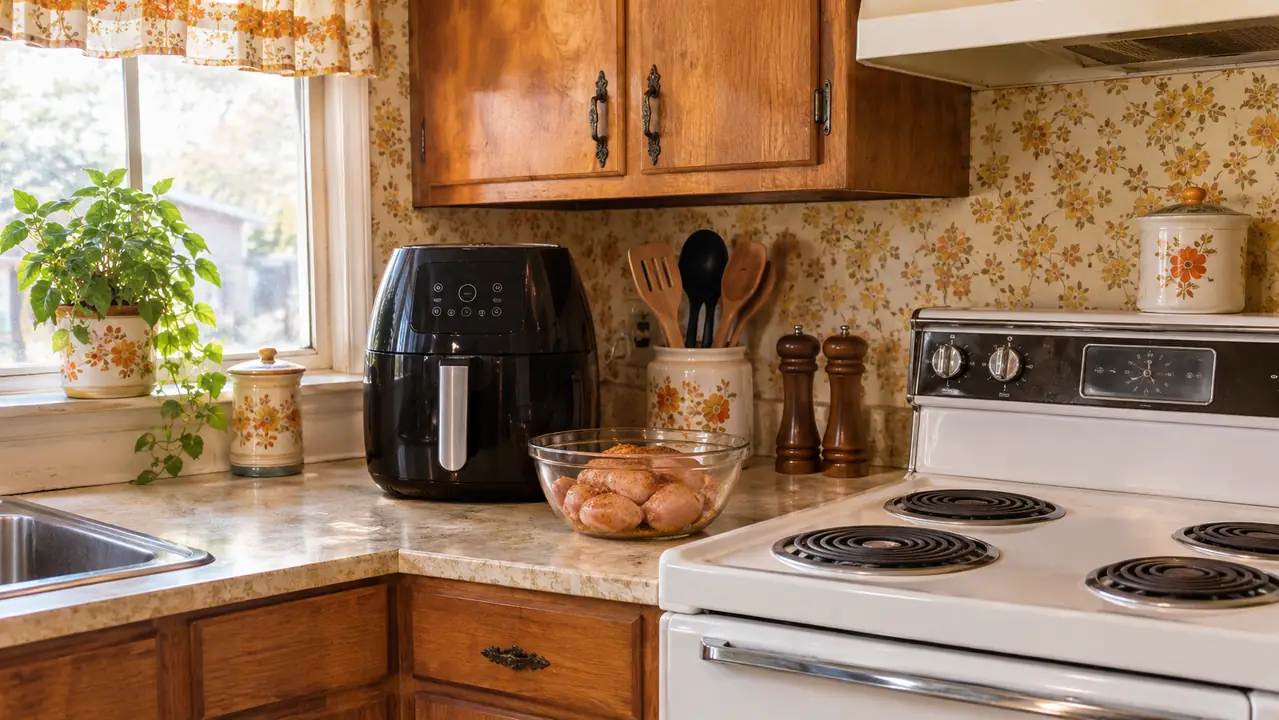
I bought the Ninja AF101 in early March with my own money, and it has not left my counter since. That is a bigger statement than it sounds. I have about eight feet of usable counter in this kitchen, an electric range, one wall oven, and a single sink, so anything that lives out in the open has to be doing real work three or four nights a week. This one does.
Before March I had no air fryer at all. I crisped things in the wall oven, which meant heating a whole appliance to make two chicken thighs and then living with a hot kitchen for the rest of the evening. Twenty-six years running a school cafeteria taught me what a hot kitchen feels like in August, and I was not eager to keep volunteering for it at home. What I wanted was something that cooked dinner for two quickly, washed up without a fight, and did not need a manual to operate. The Ninja AF101 is close to that. Not perfect. Close.
The Quick Verdict
A four-quart workhorse that fits dinner for two in one basket and washes in the dishwasher. The touch panel takes some learning and the basket needs a shake halfway through, but after eight months it has earned its counter space.
Amazon Check Today's Price →See what the four-quart Ninja is going for right now
Same model I bought in March. Today's price is on the listing, along with the current review count, which tells you more than any single write-up can.
Amazon Check Today's Price on Amazon →How I've Used It
I cook dinner for two most nights. Gary and I are 66 and 64, retired, and we eat at home almost every evening. The Ninja gets pulled into service three or four nights a week: bone-in chicken thighs, salmon fillets, roasted broccoli and carrots, frozen fries when the grandkids come for Sunday dinner, and reheating leftovers that would otherwise go rubbery in the microwave. On Sundays, when the family comes and there are more than two of us, I run two batches. Sometimes three.
That is the number that matters if you are shopping. One basket of this size equals dinner for two adults, comfortably. It does not equal dinner for six. I knew that going in and it has never bothered me, but I have watched people buy a four-quart and then complain that it does not feed a family of five, and that is a shopping mistake, not a product flaw. If you routinely cook for more than three, read the comparison piece on this site about the bigger model before you spend anything.
I have never owned a bigger air fryer. Everything I know about a five-quart comes from my daughter Karen's kitchen and from reading listings, so I am not going to pretend to be an expert on what I have not lived with. What I can tell you is what eight months of steady use does to a four-quart Ninja, which is the only thing I am qualified to talk about.
The Basket Is the Whole Story
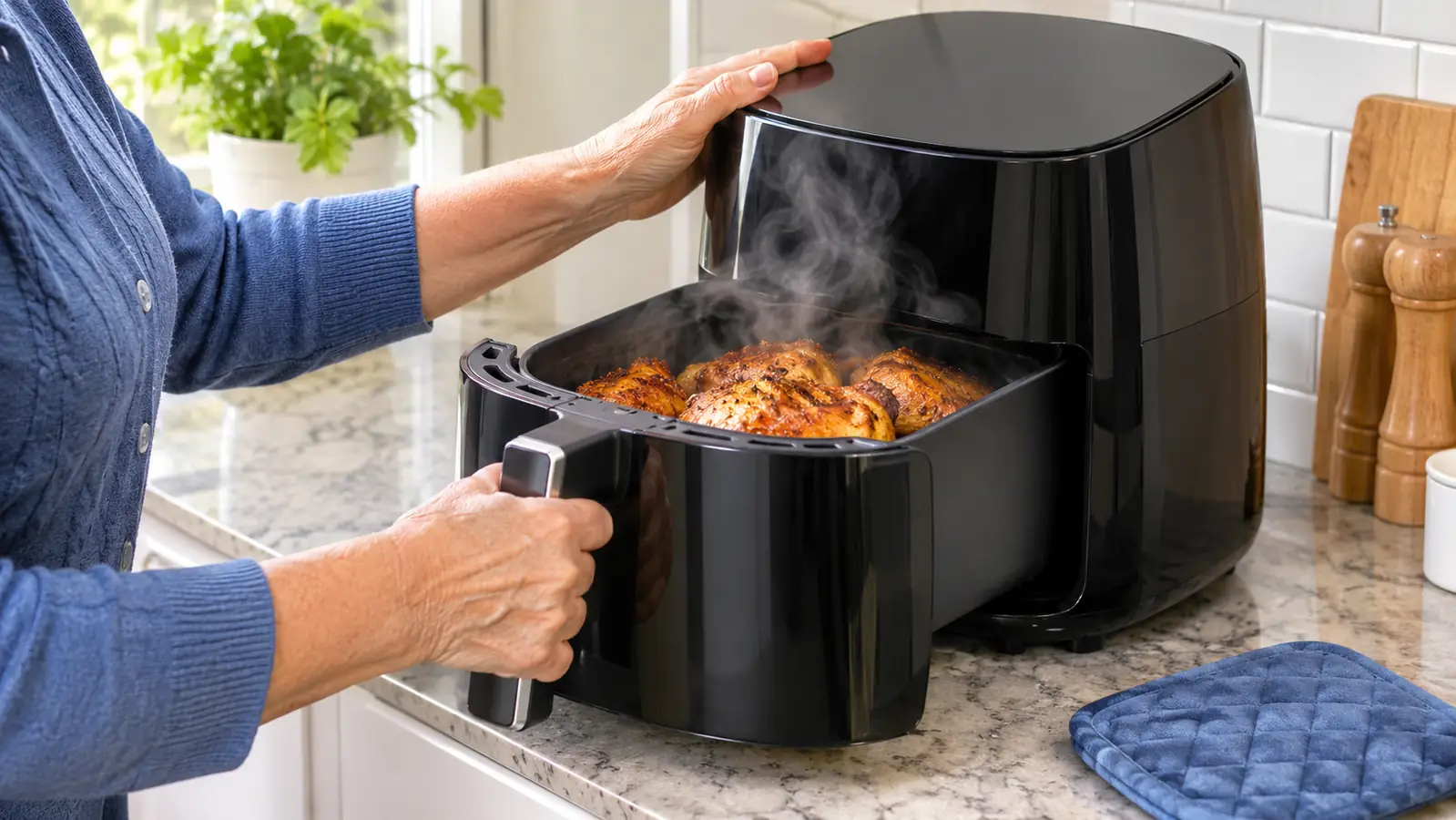
A four-quart ceramic-coated nonstick basket and crisper plate, rated to fit two pounds of French fries. That is the spec. In practice, two pounds of fries is more fries than Gary and I should be eating in one sitting, so the basket has never once been the limiting factor for us. Two chicken thighs and a handful of broccoli florets sit in there with room to spare, which matters because crowding is what turns roasted food into steamed food.
The crisper plate is the piece I would not want to live without. It lifts the food off the bottom so the air moves underneath, and the difference between cooking on the plate and cooking without it is the difference between crisp and soggy on the underside. It washes clean with a sponge and a little soap, and both the basket and the plate are dishwasher safe, which is how they get washed in this house most nights because Gary does the dishes and he is not looking for extra work.
The whole unit measures about 13.6 inches deep, 11 inches wide and 13.3 inches tall, and weighs in around 10.6 pounds. That last number is worth thinking about if you plan to move it in and out of a closet. Ten and a half pounds is not heavy, but it is not a toaster either, and you will feel it on a top shelf. Mine stays out. I know people who store theirs in a pantry and set it on the counter every time they want fries, and I respect the discipline but I do not share it.
Because here is the thing about a small kitchen. An appliance you have to unpack, plug in, use, cool down, wipe and repack does not get used on a Tuesday. It gets used on a Sunday when you have energy. The Ninja earns its spot because it is already there, already plugged in, and the whole job is pull the basket out, put it back, press a button.
What the Four Programs Actually Do for Me
The panel offers Air Fry, Roast, Reheat and Dehydrate, and the temperature range runs from 105°F up to 400°F. Controls are touch, not a dial, which took me about a week to stop resenting. After twenty-six years of turning knobs in a cafeteria, I like a knob. A flat panel means looking at it, and looking at it means my reading glasses. That is a small complaint, but it is a real one if your eyes are like mine.
Air Fry is the setting I use for probably eighty percent of what comes out of this machine. Chicken thighs at 380°F for a little over twenty minutes, turned once, come out with the skin properly crisp and the meat still juicy. Salmon is faster and less forgiving. Vegetables need a shake and less time than you think, and the first time I did broccoli I overdid it and got something closer to charcoal florets. I have since learned to check at twelve minutes.
Roast I use for larger items or when I want a gentler cook. Reheat is the setting that surprised me most. Leftover pizza, leftover fried chicken, a piece of meatloaf that would have gone bouncy in the microwave all come back with a texture that is close to what they were the first time. I did not expect to care about a reheat button. I care now.
Dehydrate is the one I have used least. It works at low temperature with low fan speed, and the booklet that ships with the unit has twenty recipes if you want a starting point. I did a batch of apple slices in the fall and they came out fine, but drying fruit is not how I spend a Tuesday and I am not going to pretend otherwise. If dehydrating is the main thing you want, read up before you buy, because it is a slow process and the four-quart basket limits how much you can do at once.
Eight Months In: What Changed and What Didn't
The honeymoon period ends around month two. New appliances get used for everything, then you settle into what they are actually good at. Here is where I landed.
Chicken thighs are now a weeknight staple in a way they never were before. I buy the bone-in, skin-on pack, season them plainly, and they are done in under half an hour with a crisp skin and no splatter on the stove. In the wall oven this took longer and heated the whole kitchen. That is the honest core of why this thing has stayed on my counter.
Roasted vegetables improved my dinners more than I expected. Broccoli, cauliflower, carrots, brussels sprouts cut in half, tossed with a little oil and salt at 400°F, shaken once. They come out with browned edges instead of the limp steamed texture that made me stop bothering with vegetables for years. I am eating more vegetables at 64 than I did at 40, and a small appliance deserves some of the credit.
The nonstick coating has held up well. I have not been gentle with it, but I have not been stupid either: no metal tongs, no scouring pad, and it still releases food cleanly. That is eight months, not eight years, so I am not making promises about the long haul. A one-year manufacturer warranty is what the listing says, and that is what it is.
An appliance you have to unpack, plug in, use, cool down, wipe and repack does not get used on a Tuesday. Mine stays out because the whole job is pull the basket, put it back, press a button.

The Annoyances, Since You Asked
It is loud. Not vacuum-cleaner loud, but you will raise your voice if someone walks into the kitchen while it is running. The fan is doing the work, so I understand why, but it is not a quiet machine and I would not put one in an open-plan living room and expect to watch television in peace.
The outside gets warm. Not hot enough to burn you on a passing brush, but warm enough that you should not park it against a wall or under a cabinet with no clearance. Mine sits to the left of the range with open air above it, which is what the manual wants anyway.
Food needs shaking. This is true of every air fryer and I am not going to pretend otherwise. If you fill the basket and walk away, the top browns and the bottom does not. Twenty minutes of chicken means getting up once, pulling the basket out, shaking it, and sliding it back. If that sounds like too much, an air fryer is not for you.
And the cleanup, while easy, is not nothing. The basket and plate go in the dishwasher, but the inside of the unit itself collects grease over weeks and needs a wipe down now and then. I do it about once a month with a damp cloth and a little dish soap. Five minutes of work. Worth mentioning because nobody mentions it.
What I Liked
- Four-quart basket fits dinner for two adults with room to spare, so food browns instead of steaming
- Basket and crisper plate are dishwasher safe, which matters on a weeknight
- Reheat setting genuinely rescues leftovers that the microwave ruins
- Roasted vegetables come out with browned edges in under fifteen minutes
- Touch panel has four clear programs and a 105°F to 400°F range, so nothing to guess at
- Ten and a half pounds is light enough to move but heavy enough to feel solid on the counter
Where It Falls Short
- The fan is loud enough that conversation in the kitchen gets difficult
- Touch controls mean looking at the panel, which is a nuisance if you need reading glasses
- Dehydrate works but the four-quart basket limits how much you can dry at once
- Food has to be shaken partway through, so you cannot truly walk away
- The unit's interior needs a wipe down every few weeks to keep grease from building up
Who This Is For
This is for someone cooking for one or two people who wants dinner on the table without heating the whole kitchen. It is for the person who has been meaning to eat more vegetables and needs the process to be easier than a sheet pan. It is for anyone with limited counter space who is willing to give up eight or nine inches of it permanently in exchange for an appliance they will actually use.
It also suits anyone who reheats leftovers regularly, which at my age is most of us. The Reheat setting alone has changed how I plan meals, because I no longer dread the second night of something I cooked on Sunday.
Who Should Skip It
If you cook for four or more most nights, skip it. You will be running batches and you will resent it. My daughter Karen has the larger model for exactly that reason, and it is the right call for her house.
If you want an appliance you can set and forget, skip it. The shaking is not optional, and the food that does not get shaken does not come out right.
And if you are short on counter space and not willing to give any up, be honest with yourself about whether you will unpack it every time. I have watched more than one small appliance go into a closet and never come back out. That is not the Ninja's fault, but it is the reason a lot of air fryers end up at yard sales.
One more thing. I have not owned a bigger air fryer, so I cannot tell you from experience whether a five-quart does anything this one does not. The comparison article on this site covers that ground. What I can tell you is that after eight months, cooking for two, I have never once wished this basket were larger.
Eight months in, still on my counter. Here is today's price
Four-quart basket, touch controls, dishwasher safe parts, and a reheat setting that earns its keep. Check the current price and the review count on the listing before you decide.
Amazon Check Today's Price on Amazon →