
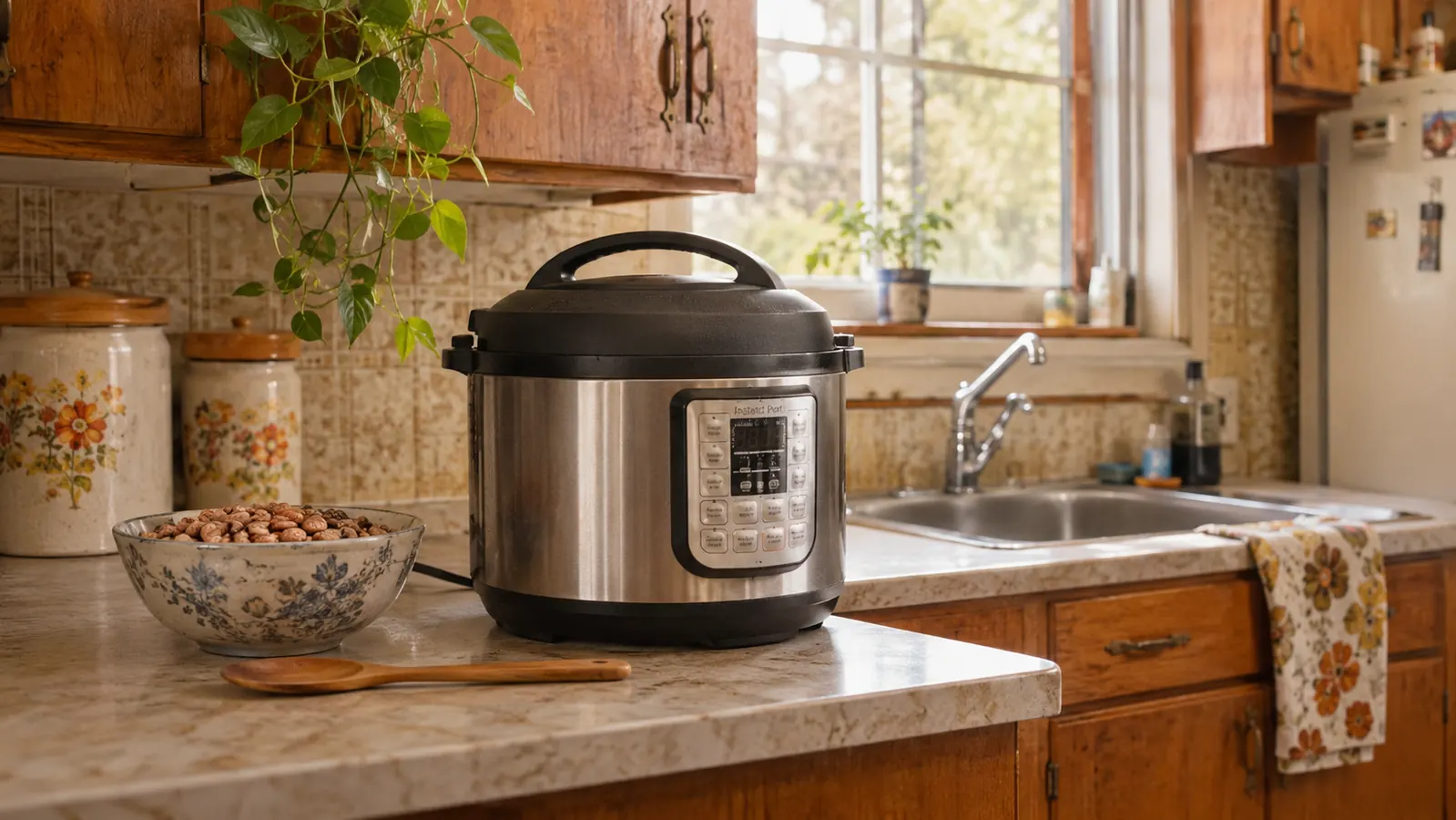
Last October I set the Instant Pot Duo on the counter where a round Crock-Pot had sat for about twenty years, and Gary asked me from the doorway whether I really needed another appliance. Fair question. This kitchen has about eight feet of usable counter, one sink, a wall oven and an electric range, and I have been cooking for two since I retired from twenty-six years running a school cafeteria. Every appliance in this house earns its spot or it goes into the pantry closet. I bought this one myself, with my own money, the way I bought the other four.
A year of use later, here is the short answer. It earned the spot, but not for the reasons printed on the box. The seven functions are not seven separate appliances, and the front panel makes a few promises the pot does not keep. What it actually did was retire my stock pot, cut about forty minutes out of bean night, and turn Sunday chili into something I start in the morning and forget about. What it did not do was replace my Dutch oven, and I want to be straight with you about that before you spend anything.
The Quick Verdict
One pot that pressure cooks, slow cooks and holds a Sunday batch of chili without living on my counter all week. The panel oversells itself and the lid has a learning curve, but mine has run two or three times a week for a year and I would buy it again.
Amazon Check Today's Price →Twenty years of beans on the stove, retired in one afternoon
Six quarts of stainless steel, thirteen programs on a push button panel, and a lid that has to lock before it will build any pressure. Mine has run two or three times a week for a year without a single false start.
Amazon Check Today's Price on Amazon →How I've Used It
I did the water test the first night, the way the little booklet tells you to, and then I sat at the table and read the whole thing because I am that person. The first real cook was dried kidney beans, no soak, and I stood in front of the pot expecting to be disappointed. They came out soft and whole and I have not bought a can of beans since. That is the whole review in one sentence, honestly, but there is more worth saying.
Since then it comes out of the closet two or three times a week. Dried beans, pot roast, chicken stock from the Sunday carcass, rice, a pot of soup when the weather turns, eggs for Gary's lunches, and chili for the family on the Sundays the grandkids come, which is about twice a month. Six quarts is rated for up to six people, which is the right size for those Sundays and generous for the two of us on a Tuesday. That generosity is part of why it lives in the closet instead of on the counter.
I use the slow cook setting maybe once a month, usually when I want chili to sit all afternoon and I do not want to think about it. Mostly I pressure cook, and the Instant Pot has done that job two or three times a week for a year now without a failed seal. And here is the thing I would tell anyone standing in the store aisle: the cook time on the display is not the whole story. A twenty-five minute bean cook is closer to fifty minutes by the time the pot comes up to pressure and comes back down. It is still faster than my stove. It is not quick.
The first month was mostly me getting the timing wrong in the other direction. I undercooked a chuck roast badly enough that Gary sawed at it politely for a while and then asked if there was more gravy. That was a two pound roast given forty minutes because I had convinced myself the seventy percent number on the box applied to everything. The next week I gave the same cut sixty-five minutes with a natural release and it fell apart under a fork. What I learned is that this pot wants you to write things down. There is a pencil mark on the inside of the cupboard door now, a short list of what worked, and I add to it maybe once a month.
What the 13 Programs Do in a Real Kitchen
The listing says thirteen customizable Smart Programs, and the ones it names are ribs, soups, beans, rice, poultry, yogurt, desserts and more. Here is the translation. Most of them are the same pressure cycle with a different default time, and once you understand that, the panel stops being intimidating and starts being a shortcut. Beans has a time already set. Rice has a time already set. You press one button instead of standing there holding a plus sign with a wet hand.
The two I use as genuinely separate things are rice and yogurt. Rice because it comes out the way Gary likes it, separate grains, and I do not have to watch a pot boil over on the stove while I am doing something else. Yogurt because it holds a low steady temperature for hours, and that is the one job in this kitchen nothing else I own can do at all. Eggs I do by time rather than by a preset, because I like them a certain way. The rest of the panel I mostly ignore, and I do not feel like I am missing anything.
The listing also claims up to seventy percent faster than traditional cooking, and my honest read is that it depends entirely on what is in the pot. Beans, stock, and a chuck roast that usually needs three hours in the oven, yes, easily. Anything that already cooks in ten minutes on a burner, no, because you spend most of that saved time waiting for pressure to build and then waiting for it to drop. This pot rewards food that takes a long time. It punishes food that does not.
Why It Lives in the Pantry Closet
It weighs fourteen and a half pounds empty. It measures about twelve inches deep, thirteen wide and twelve and a half tall, which is not a small object. Set beside a toaster it looks reasonable. Set on eight feet of counter that also has to hold a coffee maker, a cutting board and whatever I am chopping, it looks like a decision. The first month I cleared it a permanent spot by the sink, and then I gave that spot back, because I do not use it every day and I do use the counter every day.
I measured that spot before I gave it up, because I wanted to know what I was actually losing. Thirteen and a third inches wide against a stretch of counter that runs maybe thirty inches between the sink and the range, and the coffee maker already claims eleven of them. That left me about six inches of working room for a cutting board, which is not enough to chop an onion without chasing it around. The pot was not the problem. The pot was just the last thing to arrive.
The pantry closet is three steps from the stove and the outlet by the sink reaches it, which is not true of everything in this house. Fourteen pounds is a two handed lift when it is empty and more than that when it is full of chili, so I carry it with both hands and set it down before I open anything. If you have shoulder trouble, put it where you will use it and leave it there. That is the honest advice, and it is also the reason I would not want a bigger one than six quarts.
The Lid, the Seal and the Wash-Up
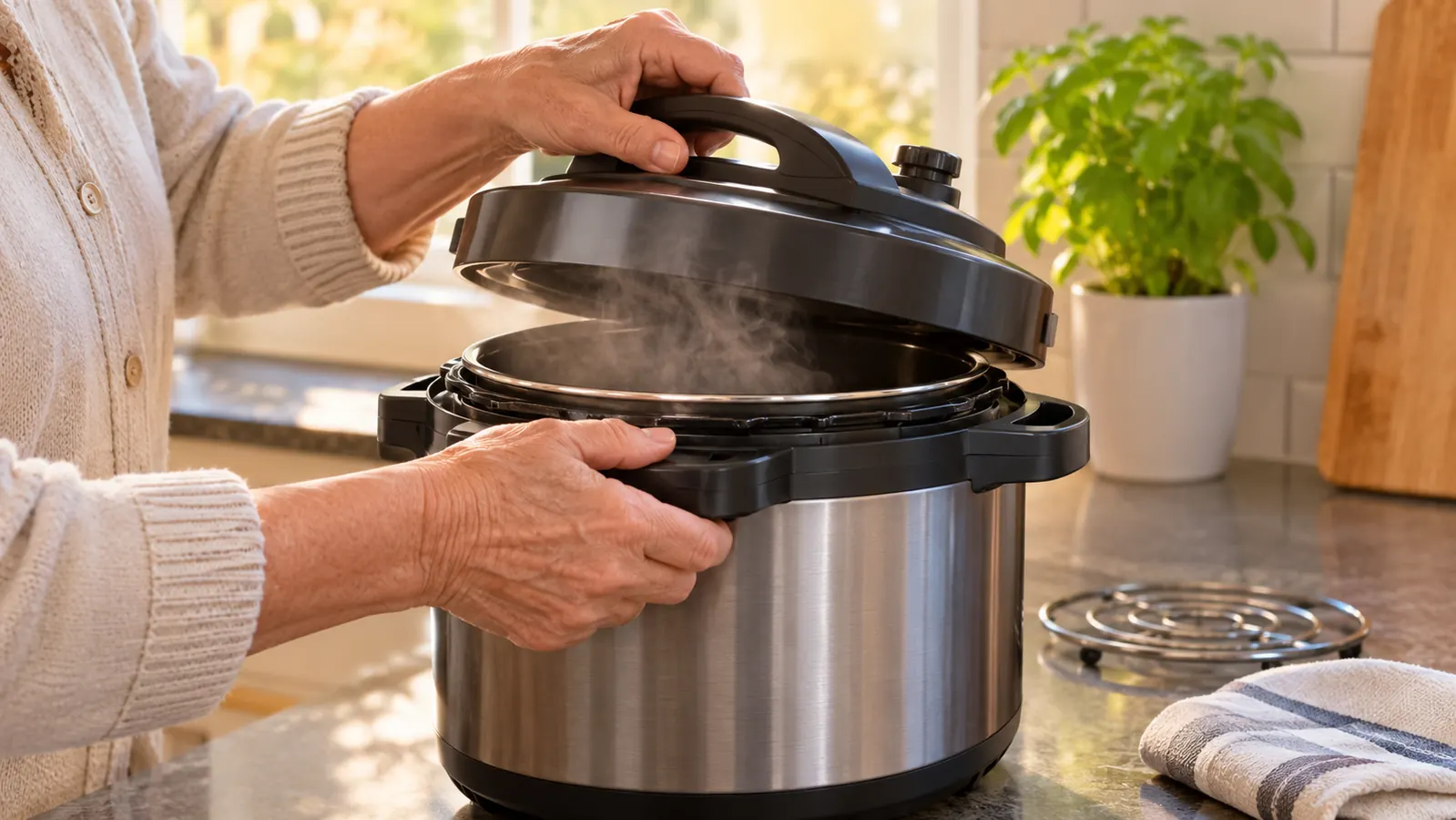
The lid is the part with a learning curve. It locks, and the pot will not build pressure until it is locked properly, which sounds like a warning and is really a kindness, because a bad seal turns into a pot that sits there quietly instead of a mess on the ceiling. My first three attempts I stood over it listening. Now I set it and walk away. The listing mentions over ten safety features plus overheat protection and a safe-locking lid, and while I have not tested any of them on purpose, nothing in a year has given me a reason to worry about this thing running in a house with two grandchildren in it.
Cleanup is a stainless inner pot that goes into the sink with everything else, and a sealing ring that I take out and rinse. That ring is the one thing I would warn you about. It holds odor. My first batch of chili left a smell in it that showed up faintly in the next pot of rice, and the fix was soaking it in warm water with a little baking soda. Now I keep a second ring in the drawer, one for savory and one for anything sweet, and the rice tastes like rice again.
There is a small ritual to the whole wash up that took me a few weeks to settle into. The inner pot soaks while we eat, because the bottom of a bean cook sets up like cement if you let it go cold overnight. I learned that the hard way in November, scrubbing at nine at night with a nylon brush and a lot of opinions. Now it gets hot water in it before the bowls even hit the table, and by the time Gary takes over at the sink it wipes out in under a minute.
The outside of the pot wipes down and that is that. The controls are push buttons on a flat membrane, so there is no dial for grit to get behind, and I appreciate that more than I expected to. Twenty-six years of wiping down cafeteria equipment taught me that the fewer seams on the front of a thing, the longer it stays out of the repair pile. One year manufacturer warranty, which is worth knowing and worth writing on the inside of the cupboard door.

Where It Fights You
You cannot open it and taste. That is the whole tradeoff of the Instant Pot and it deserves saying plainly, because the first time you make soup in this thing you will want to adjust the salt at the twenty minute mark and you will not be able to. I season at the end now, every time, and I keep a note card in the drawer with the amounts that actually worked. If you are a cook who tastes as you go, and I am, this is the part that takes adjusting.
It also takes real time on both ends. Coming up to pressure is slow and coming down is slower, and the natural release in particular is where a weeknight dinner slides to nine o'clock if you are not paying attention. Six quarts for two people also means leftovers, which is fine by me because I freeze them, but if you cook for one and you resent the freezer, get a smaller one. And the lid comes off completely with nowhere to put it. It does not sit flat on my counter without rocking, so it goes upside down in the sink. Small thing. Bothers me every time.
What I Liked
- Beans, stock and pot roast go from an all day project to an afternoon, and they come out better than my stove version
- The stainless inner pot goes straight into the sink, with no coating to baby along
- Thirteen programs means one button for rice and beans instead of standing at the stove stirring
- The lid will not build pressure unless it is locked, which has saved me from myself more than once
- Six quarts holds a Sunday batch for the family and still fits on a pantry shelf
Where It Falls Short
- The cook time on the display leaves out coming up to pressure and coming back down, so a twenty-five minute cook is closer to fifty
- The sealing ring holds odor until you soak it, and mine now has a twin in the drawer
- You cannot open it and taste as you go, so seasoning happens at the end
- Fourteen and a half pounds empty, more than that full, and it is a two handed lift
- No home for the lid. It comes off completely and rocks on the counter
Twenty years of dried beans meant an overnight soak and an hour at the stove. Now they go in dry, I set the time, and I go sit down.
Who This Is For
Buy it if you cook dried beans, stock, tough cuts or a big pot of soup more than once a month, and if you have a closet or a low shelf where a fourteen pound pot can live between jobs. It suits a household of two that cooks like a household of four and freezes the difference, which is exactly what this house does. It also suits anyone still keeping a slow cooker for the single reason that they like coming home to dinner already made, because the slow cook setting does that job and the pressure cook setting does two more on top of it.
It suits a Sunday cook, too, and I mean that specifically. The Sundays the grandkids come, I am feeding four adults and two children who all want to be somewhere else in twenty minutes. Chili goes on in the late morning, sits, and is ready when the doorbell starts ringing. The part I did not expect is that the Instant Pot frees the stove, which means the oven is open for cornbread at the same time. In this kitchen that is worth nearly as much as the time saved.
Who Should Skip It
Skip it if your dinners are mostly quick things. A piece of fish, a skillet of vegetables, a pan of pasta. This pot has nothing to offer food that already cooks in ten minutes, and you will resent the shelf space it takes up. Skip it if you want one appliance that replaces your oven, because it will not brown anything worth browning and it will not crisp anything at all. And skip it if fourteen pounds is a lift you would rather not do two or three times a week, because there is no version of this pot that gets lighter.
A year in, it still comes out of the closet two or three times a week
Six quarts, thirteen programs, a stainless inner pot and a lid that will not pressurize until it is locked. If you cook beans, stock or a Sunday roast, this is the one I would hand you.
Amazon Check Today's Price on Amazon →