
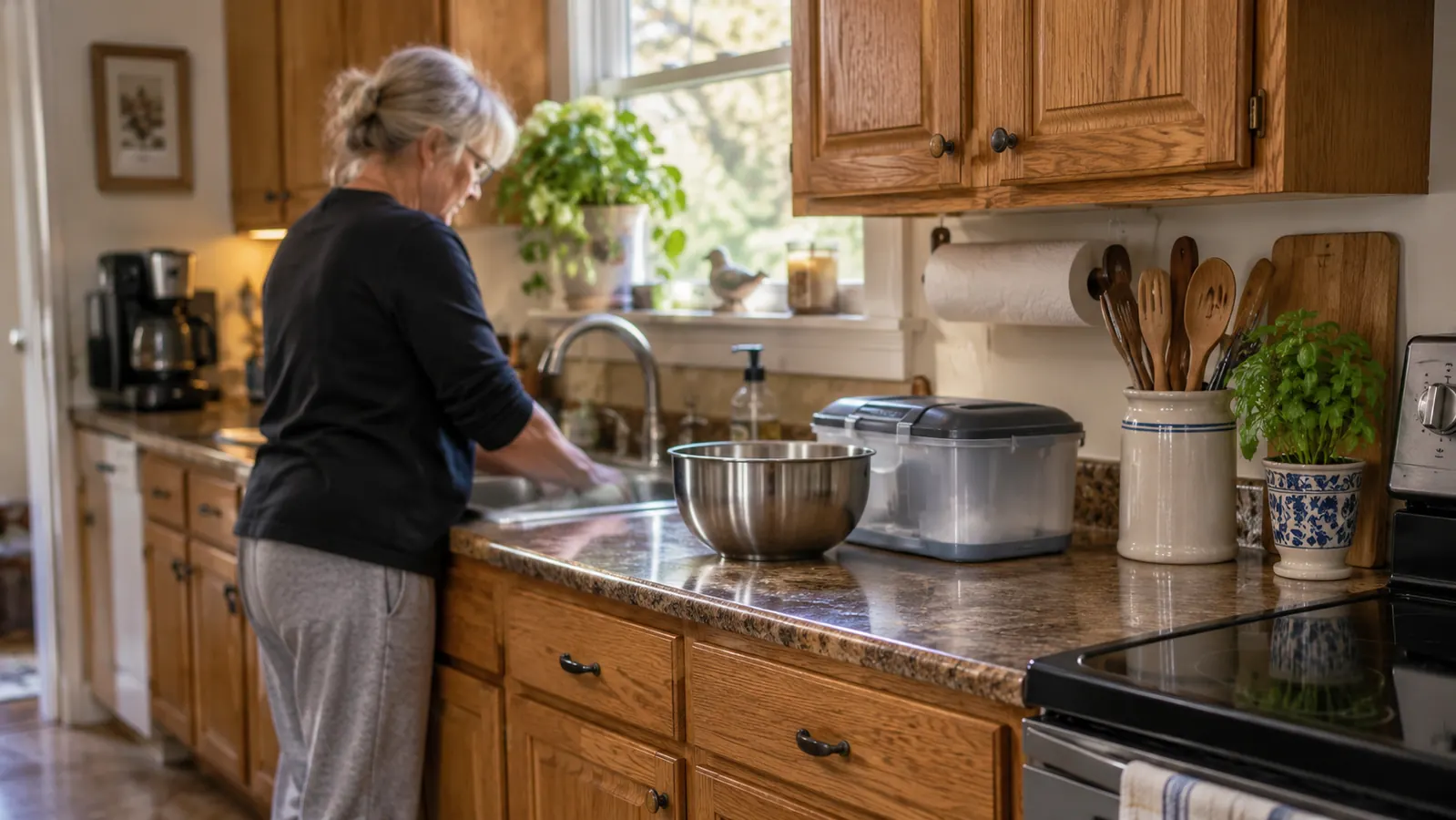
Stand mixers are wonderful machines. I spent 26 years running the big floor models in a school cafeteria, and I know exactly what they can do. But that was a kitchen feeding a few hundred kids a day, with a stainless steel table devoted to nothing but that mixer. My kitchen in Nashua has about eight feet of usable counter, a single sink and a wall oven. Every appliance has to earn its spot. That is the whole argument for a hand mixer, and the one I reach for is a Hamilton Beach 6-speed I bought about four years ago.
It lives in a drawer in its snap-on storage case, not on the counter. It comes out for Sunday desserts, whipped cream, cookie dough, mashed potatoes and egg whites, roughly once a week. It has cost me zero inches of counter, which around here is the most expensive thing a kitchen owns. Here are ten reasons it beats a stand mixer in a small kitchen, and a couple of places where it honestly does not.
The mixer that earned its drawer
Six speeds, a QuickBurst button and a storage case that keeps the beaters and whisk together. Four years of weekly use in a kitchen with eight feet of counter.
Amazon Check Today's Price on Amazon →It lives in a drawer instead of owning counter space
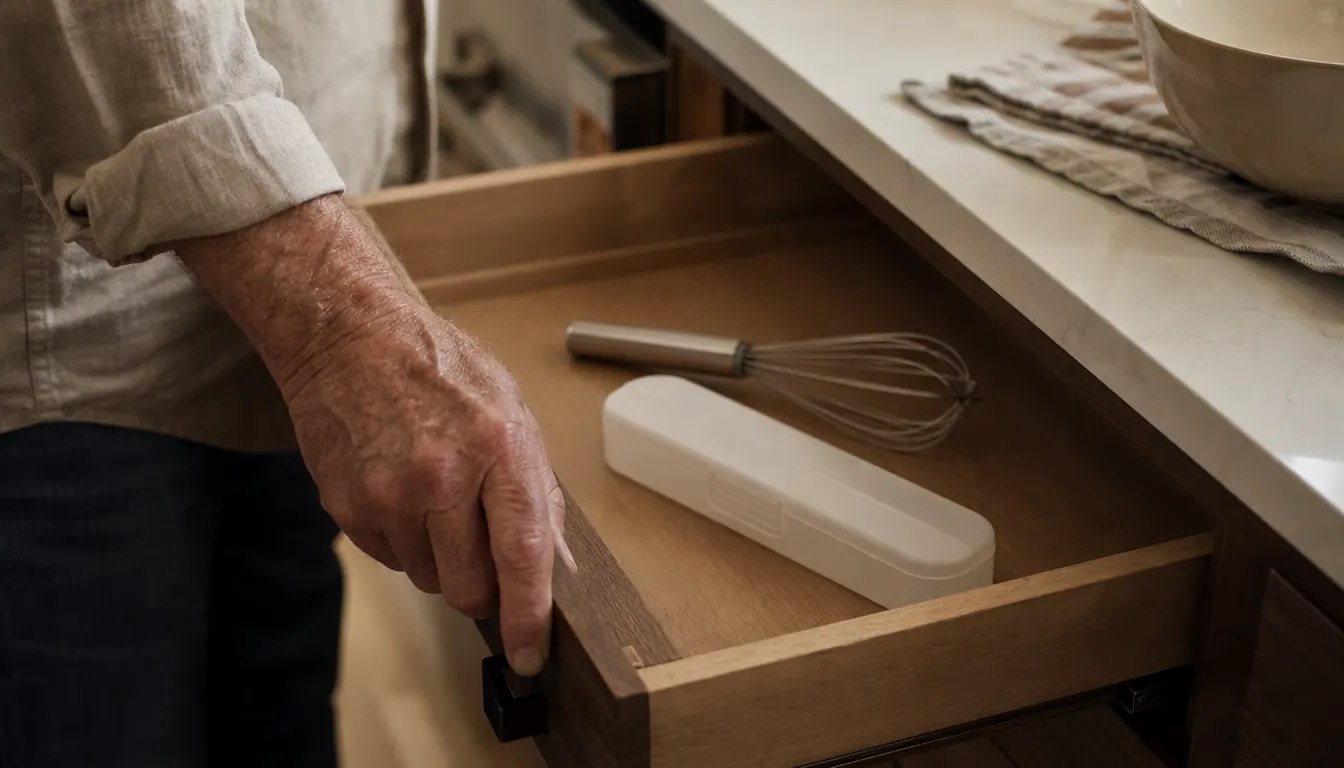
A stand mixer has to stay out in the open, because it is too heavy to haul around twice a day. Mine is 8.3 inches deep, 5.7 inches wide and 9.2 inches tall, and it goes into a drawer with the case closed. That is the entire trick. In a kitchen with eight feet of counter, the toaster and the coffee maker already split what is left. An appliance that only appears when it is needed is worth more than one that is permanently in the way.
Ten seconds from drawer to mixing
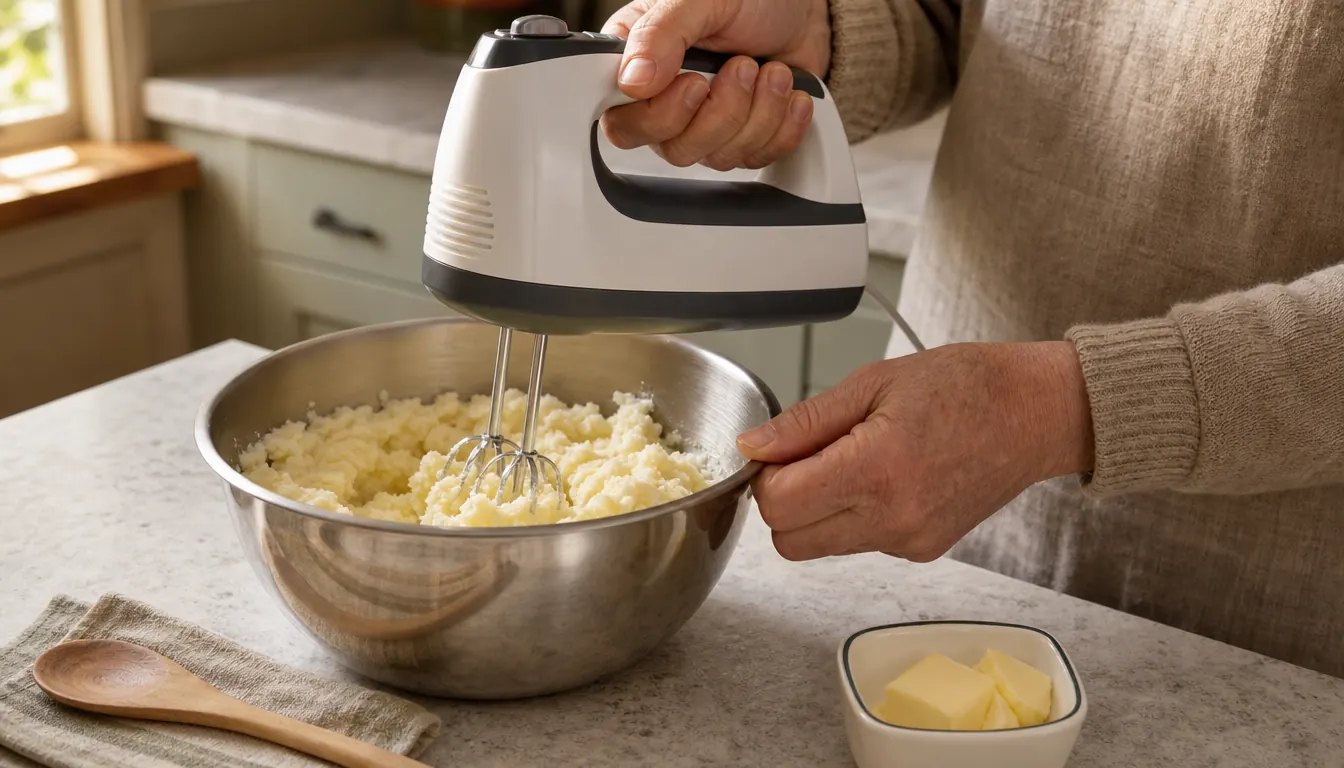
Open the case, push the beaters into the spindle until they click, plug it in. The spindle is detachable, so the beaters come out for washing and go back without a fight. Gary does the dishes most nights and he has never once had to ask which beater goes where, because they only fit one way. A stand mixer is not slow to set up, exactly. It is just enough of a production that I talk myself out of it for small jobs.
Six speeds and a QuickBurst button cover most jobs
Six speeds plus a QuickBurst button handle nearly everything I make. The low end folds, the top end whips, and QuickBurst gives a short burst of power when the cream is almost there or the potatoes need one more pass. It is 250 watts, which is plenty for egg whites and cookie dough and not enough for bread dough, and I will not pretend otherwise. If a machine exists in your kitchen only to knead, this is the wrong tool. For everything else in my rotation it does the job.
The beaters and whisk go in the dishwasher
Press the speed dial and the beaters release. The two traditional beaters and the whisk are all dishwasher safe, so they ride along with the dinner plates and come out clean. That matters more than it sounds. The messy part of a stand mixer is a bowl the size of a helmet plus a beater housing that has to be wiped by hand, and on a Tuesday night I am not wiping anything by hand that I do not have to.
You can scrape the bowl while it runs
With a hand mixer, you scrape as you go. When I need both hands, the bowl rest lets me set the mixer on the rim of the bowl while I add flour or get at the bottom with a spatula. A stand mixer does its own thing, which is fine until the butter is stuck in a ring at the base and you are stopping it every thirty seconds anyway. On small batches, my hand on the machine is better control than a head that locks down.
Four years, roughly weekly, still on the original beaters and still starting on the first press.
Five feet of cord actually reaches the outlet
The cord is five feet, which sounds like a detail until you have owned a short one. My outlet is behind the coffee maker by the sink. Five feet gets me from there to the stretch of counter by the range with slack left over, so I am not unplugging the coffee maker to whip cream. The mixer I had before this one had a shorter cord and I used an extension cord for a decade. I do not miss it.
The snap-on case keeps every attachment together
The snap-on storage case holds the two beaters and the whisk in the same place as the mixer. Before this I had a drawer full of loose attachments and one whisk that lived somewhere else entirely. Now the whole thing is a single object. I open the drawer, take out one case, and everything I need is inside it. Four years in I have not lost a beater, and in my kitchen that is a genuine record.
Light enough to hold in one hand at 64
It is light enough that I hold it in one hand while the other hand works the bowl, and at my age that counts for something. The housing is plastic, the beaters are stainless steel, and it has never made my wrist complain. The heaviest thing I lift out of that drawer is the case, and even that is nothing. A stand mixer is a two-hand appliance whether the manual admits it or not, because you are lifting a loaded bowl out of it afterward.
Mashed potatoes for two do not need a helmet-sized bowl
Mashed potatoes for two, whipped cream for four, one batch of cookie dough. These are small jobs and a small machine suits them. A stand mixer bowl has a minimum useful batch. Go too small and the beater never reaches the bottom, so you make more than you need or you scrape constantly. My sister Carol bakes in volume and her stand mixer earns its counter. For Gary and me, plus the grandkids about twice a month, two smaller batches work fine.
Four years in and it is still on the original beaters
I bought this Hamilton Beach about four years ago to replace a hand mixer from the 1990s whose motor finally quit. It still runs on the original beaters and still starts on the first press. The warranty is one year limited, which is honest for the category. Four years of roughly weekly use is a better answer than any spec sheet I could quote you. If it dies tomorrow I will buy the same one, and I would rather say that plainly than pretend a plastic appliance lasts forever.
What I'd Skip
Two things I would skip. The first is a stand mixer in a kitchen this size, unless you bake bread or sheet cakes every week and can leave the machine out. The second is any hand mixer with no home for its beaters, because loose attachments are how a drawer turns into a junk pile. If you already own a stand mixer and you love it, keep it. The Hamilton Beach is not replacing a machine you use. It is replacing the machine you avoid because getting it out is a chore. And if you do bake four loaves at a time, be honest with yourself and buy the big one, because this is not that machine.
If your counter is tight, this is the one I would buy again
It fits in a drawer, the beaters go in the dishwasher, and it handles everything a two-person kitchen asks it to do. See today's price on the listing.
Amazon See Today's Price on Amazon →