

Here is the short answer, and then I will show my work. For a kitchen with eight feet of counter and two people at the table, the Hamilton Beach 6-Speed hand mixer is the appliance that earns its spot. A stand mixer is the better machine for bread dough and for any batch big enough that you want to walk away from it while it works. Those are two different jobs, and in a small kitchen you usually only have room, and patience, for one of them. Everything below is about which job you actually have, not which machine wins some absolute contest, because they are not really competing for the same square of counter.
I spent 26 years running the mixers in a school cafeteria, the floor models on pedestals that took a 60 quart bowl and never got tired. Then I came home to my own kitchen in Nashua, where the counter runs about eight feet, and creamed butter with a fork like everybody else. I bought the Hamilton Beach hand mixer about four years ago, after a hand mixer from the 1990s quit in the middle of a batch of Christmas cookies. My sister Carol owns a KitchenAid Artisan stand mixer, the five quart tilt head model, and I have used it at her house more than once. I have never owned a stand mixer myself, so I am not going to pretend I have. That is the whole basis for what follows, and you should take it for what it is.
| Hamilton Beach hand mixer | KitchenAid Artisan stand mixer | |
|---|---|---|
| Where it lives | In a drawer, in a snap-on case that holds the two beaters and the whisk | On the counter, or in a low cupboard you lift it in and out of |
| Room it takes | Only the width of whatever bowl you are already holding | Its own permanent square of counter, plus clearance behind it to tip the head back |
| Bread dough | Not what it is built for. A 250 watt motor and your arm doing the kneading | Dough hook does the work while you grease pans |
| A double batch of cookie dough | It gets there, in two or three passes, with you holding on the whole time | One bowl, hands free, and you can leave the room |
| Whipped cream for two | A cold bowl and the whisk, about a minute and a half, one thing to wash | Works fine, but a five quart bowl and a balloon whisk for half a cup is a lot of machine for the job |
| Cleanup | Beaters and whisk go in the dishwasher. The body gets a wipe | Bowl, beater, often a splash guard, and a machine to wipe down |
| Mashed potatoes for a Sunday crowd | Fine in a big pot, standing at the stove, working in stages | Hands free, no arm ache, one bowl to wash after |
| Attention | You are holding it the entire time | You can walk away and load the dishwasher |
| What it costs | A fraction of a stand mixer, and no attachments to buy later | Several times more, and the add ons add up |
The Counter Space Question
Eight feet of counter sounds generous until the coffee maker, the toaster and the dish rack take their positions. Gary and I cook dinner most nights, bigger batches on Sundays when the family comes, and anything that is not used daily goes in the pantry closet. The Hamilton Beach hand mixer measures 8.3 inches deep, 5.7 inches wide and 9.2 inches tall, and it weighs 1.3 kilograms, a little under three pounds. It lives in a drawer in the snap-on storage case with the two traditional beaters and the whisk inside, and the drawer closes. That last part is the entire argument, and I would make it to anybody standing in a kitchen like mine.
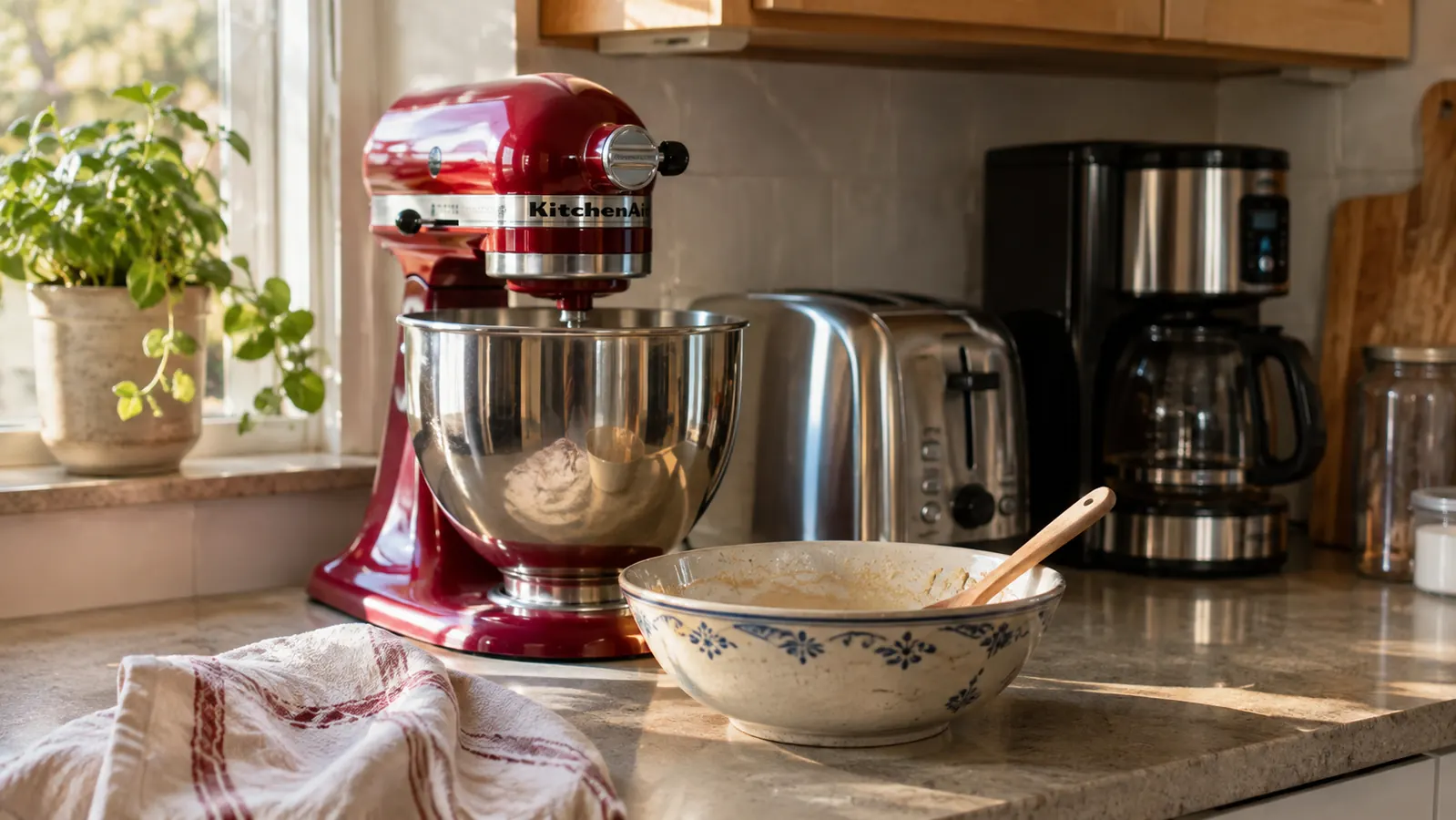
A stand mixer does not work that way. It has a base, a bowl that locks into a cradle, and a head that tips back, and it wants a square of counter that stays its own. Carol's lives on hers, and she has more counter than I do, so it fits. The people I know who own one and put it away keep it in a lower cupboard and lift it out with both hands, which means it comes out for planned baking, not for a Tuesday night when you decide at six o'clock that a cake sounds good. There is nothing wrong with planned baking. It is just a different relationship with the appliance, and it is the reason I never bought one.
Where the Hamilton Beach Hand Mixer Wins
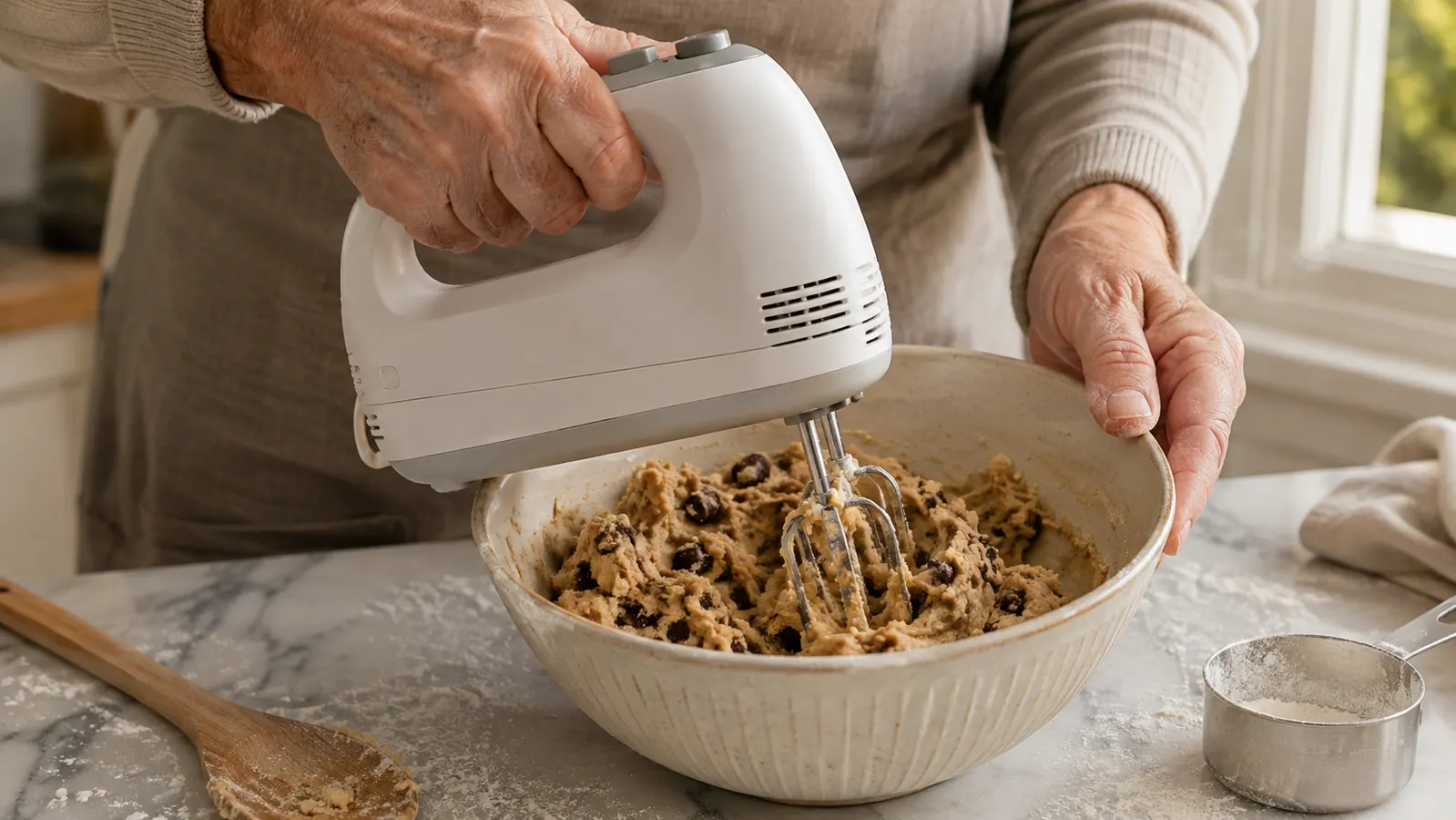
Small quantities, first, and this is most of what I actually make. Half a cup of cream for two people. Two egg whites that need to be stiff for a Sunday angel food cake. One box of brownie mix when the grandkids are coming and I have already been to the store twice. A hand mixer is in the bowl and finished before a stand mixer would have its bowl locked into the cradle. The whisk handles cream and egg whites, and the QuickBurst button gives an extra burst of power at the end, which is the exact moment you want it, when the cream is nearly there and you do not want to blow past stiff peak into butter.
Cleanup is the second thing, and it matters more every year. The two beaters and the whisk are dishwasher safe, and you press the speed dial to eject them straight into the sink instead of fishing around with wet hands. What is left is the body of the mixer, which gets a wipe with a damp cloth. Compare that with a bowl, a beater, a dough hook, a splash guard and a machine to wipe down, and the difference is not small on a night when dinner is over and Gary is already at the sink. He does the dishes most nights, and he has told me more than once which appliances he does not resent.
Storage and cost, third. It goes in the drawer in its case and the whole thing weighs under three pounds, so there is no lifting and no clearance to think about. It also costs a fraction of a stand mixer, and there are no attachments to buy later, because the beaters and the whisk that come with it are the ones I use. That matters if you are buying one appliance for a small kitchen and not setting up a bakery.
One more thing I did not expect to care about: the bowl rest. You set the mixer on the rim of the bowl when you need both hands for the flour, and it stays there instead of lying face down on the counter with batter on the beaters. It is a small feature on a machine with six speeds, and I use it every single time. The cord is five feet, long enough to reach from the drawer to the middle of my counter with room to spare, and it wraps around the base when the mixer goes back.
Where a Stand Mixer Wins
Dough. This is not close, and I will not pretend otherwise. Bread dough, a stiff cookie dough for a crowd, anything that wants five or eight minutes of kneading. The Hamilton Beach has a 250 watt motor and it handles a single batch of cookies all day long, but on bread you are the stand, and your arm is the dough hook. Carol's mixer does that work while she greases pans and gets the loaf tins out. My cafeteria mixers did it for 300 rolls at a time, and there is a reason a machine like that is built heavy and bolted to a pedestal. If bread is your hobby and not your occasional project, that difference is the whole decision.
Volume and attention, second. A five quart bowl holds a double batch of dough without it climbing the sides, and once the mixer is running you can walk away, load the dishwasher, answer the door, wipe the counter. With a hand mixer you are holding it the entire time. Four minutes for cream, longer for stiff dough, and there is no version of that where you leave the room. At 64 I notice my shoulder in a way I did not at 40. If you have hand, shoulder or wrist trouble, that is a real argument for the bigger machine and it has nothing to do with how the baking turns out.
And then there is the Sunday crowd. Four grandkids and two grown daughters twice a month means mashed potatoes for eight and a second dessert, and the hand mixer will get there, especially with potatoes in a big pot. You will just be standing at the counter longer than you want to be while the oven is on and the table is not set. A stand mixer does not make the potatoes better. It makes the twenty minutes easier, and on a Sunday that can be the point.
The mixer I own weighs under three pounds, lives in a drawer, and its beaters go in the dishwasher. In a kitchen with eight feet of counter, that is the whole case.
What Six Speeds and QuickBurst Actually Do
Six speeds sounds like a marketing number until you are the one holding the mixer. Speed 1 is for starting flour into butter without a cloud of it, and for folding. Speeds 2 and 3 do cookie dough and cake batter. 4 and 5 handle frosting and mashed potatoes. 6 is for cream and egg whites, and it is fast enough that you watch the bowl rather than walk away from it. The mistake people make is starting at 6 because the bowl is full and they are in a hurry, and then wiping flour off the backsplash for ten minutes. Start low, finish high, and the machine behaves.
QuickBurst is the button you press when the cream has reached soft peak and you want stiff, or when the butter and sugar are almost creamed and you want to finish it. You hold it, you get the extra burst, you let go. It is not a seventh speed, it is not a timer, and I would not want it sold to me as either. It is a useful button on a machine that has done four years of weekly work in my kitchen without a single repair, and it is the one I reach for most often in December.
Cleanup, Which Nobody Puts in the Listing
The snap-on case holds the two beaters and the whisk and nothing else, which means there is no hunting through the drawer for the attachment you need. Press the speed dial, the beaters drop into the sink, and the case goes back in the drawer with the attachments inside once they are dry. The one thing I would change is the case itself. It is plastic, it does its job, and it is sized exactly for those three pieces with no room for a spatula or anything else. That is a small complaint and it is the only one I have after four years.
The warranty is one year limited, which is ordinary for the category. Mine is well past that and still running, and I have replaced nothing on it, not the beaters and not the whisk. The body is plastic with stainless steel beaters, which is what you expect at this size, and it has survived being knocked around in a drawer by a woman who is not gentle with her tools. If it quit tomorrow I would buy the same one, and that is the most honest thing I can tell you about any appliance in my kitchen.
The mixer that lives in a drawer, not on your counter
Six speeds, a QuickBurst button, a bowl rest and a snap-on case for the beaters and whisk. Four years of weekly use in my kitchen and nothing replaced.
Amazon Check Today's Price on Amazon →Who Should Buy Which
Buy the Hamilton Beach hand mixer if your counter is already spoken for, if you cook for two, if you bake in single batches, and if you want the beaters and whisk washed and back in a drawer in five minutes. Buy it if you have never owned a stand mixer and are not sure you would use one often enough to justify the space it takes. That is most of the people I know, including me. It is also the appliance I would hand to someone moving into a first apartment, because it does not require a dedicated counter to be worth owning.
Buy a stand mixer, and Carol would say the same, if you bake bread more than once a month, if you double batches regularly, if you have a spare square of counter and a cupboard with clearance, or if holding a mixer for four minutes has started to hurt. If you are somewhere in the middle, buy the hand mixer first. It is the one that gets used on a Tuesday, and the machine that gets used is worth more than the machine that is better on paper. You can always add the stand mixer later, when the bread habit proves itself.
Start with the one that fits the kitchen you actually have
Six speeds, dishwasher safe beaters and whisk, a five foot cord and a storage case that fits in a drawer. Mine is four years old and still going.
Amazon Check Today's Price on Amazon →