
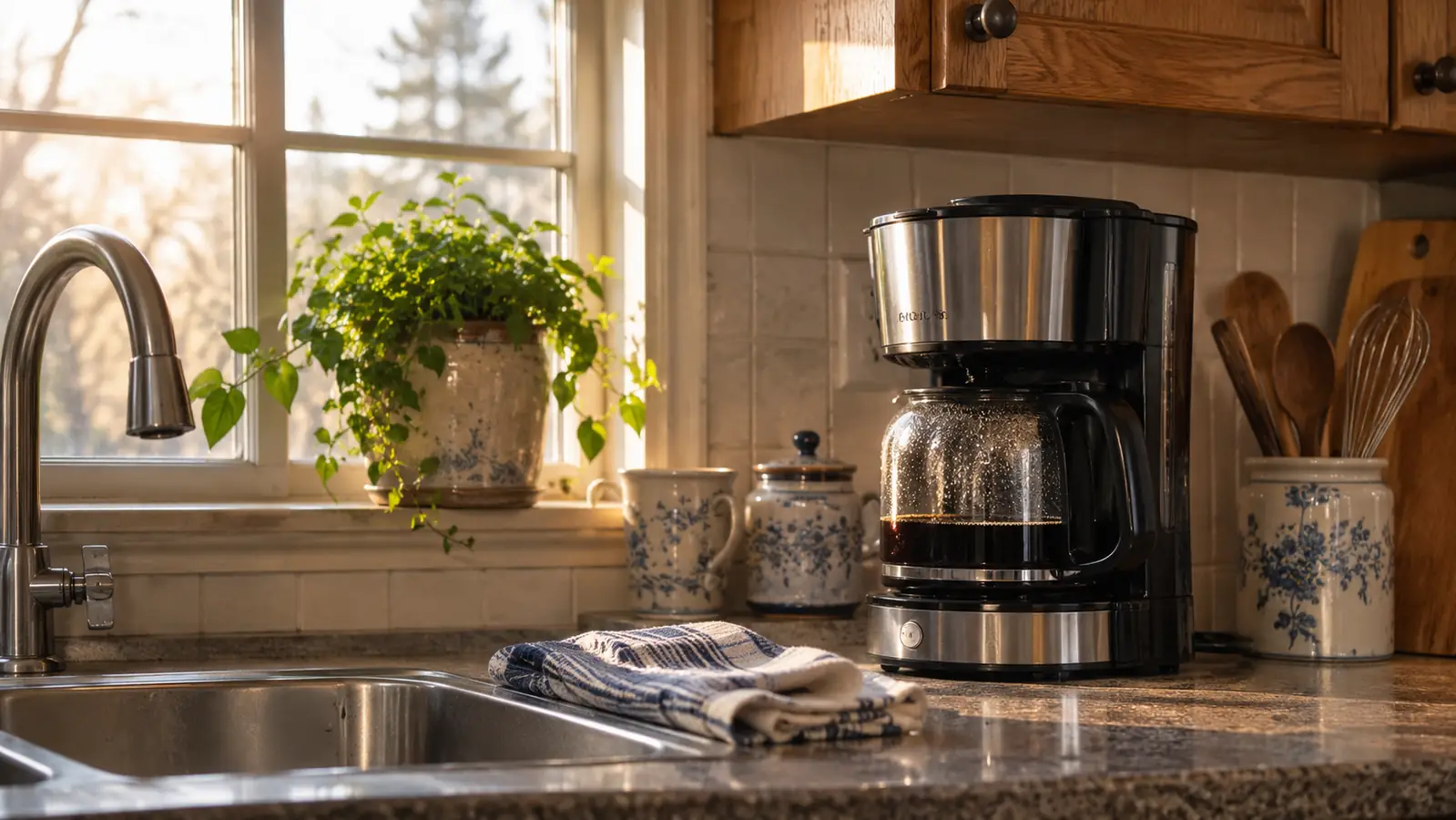
Two years of mornings with the Cuisinart Brew Central, and the thing I notice most is not the coffee. It is the small puddle of water that shows up beside the reservoir when I fill the tank too quickly. Nobody puts that in a listing photo. So I will, along with everything else that took me a while to learn.
I bought this machine myself, with my own money, about two years ago. It replaced a plain drip coffee maker with no timer that had sat on my counter for roughly eight years. The Brew Central lives by the sink now. I load it at night and it starts brewing at 6:15 the next morning, which means Gary comes downstairs to a pot that is already finished. We drink about six cups between the two of us. That is the whole ritual, and after two years I know exactly where this Cuisinart earns its counter space and where it makes me sigh.
The Quick Verdict
A reliable pot on a schedule I trust, with a few small daily frictions at the sink and at the pour.
Amazon Check Today's Price →Still the machine by my sink after two years
Twelve cups, a 24 hour timer, and a heater plate I can set to low, medium or high. If you want a pot already waiting at 6:15, this is the one I bought with my own money.
Amazon Check Today's Price on Amazon →How I've Used It, Honestly
I am not a person who fusses over coffee. Twenty-six years running a school cafeteria taught me to value a machine that repeats itself without being watched. Every day here looks the same. I fill the reservoir, check that the filter basket is seated properly, and walk away. The 24 hour programmability takes about thirty seconds to set, and in two years it has never once failed to start. That sounds like a low bar. It is not. The old maker had a timer I stopped trusting after it drifted twice in a single month.
The one morning I forgot to load it, I came downstairs at 6:40 to an empty carafe and a cold plate. Gary had already put the kettle on. We drank instant that morning and it was fine, and I have not forgotten to load the machine since. That is how far the habit gets under your skin. The night routine takes me about ninety seconds. Water to the line, basket seated, coffee leveled off with the measuring spoon, lid down, timer confirmed. I do it after the dinner dishes, before I sit down, and then I do not think about coffee again until morning.
The capacity is 12 cups, though I have brewed a full pot only a handful of times, mostly Sundays when the grandkids are here and my daughters want coffee too. On a normal weekday I use the 1 to 4 cup setting, which is the entire reason this machine suits a two person house. My old maker did not have that, so a small batch came out weak and a big batch went down the drain. Six cups is the sweet spot for us and the Brew Central handles it evenly.
The machine measures 15.59 inches deep, 11.8 wide and 9.61 tall, which matters in a kitchen with about eight feet of usable counter. I slid it under the upper cabinets with room to lift the lid, which is not something I could say for the machine it replaced. If your cabinets sit low, measure before you buy. The depth is the number that surprises people, not the height.
The Small Annoyances Nobody Mentions
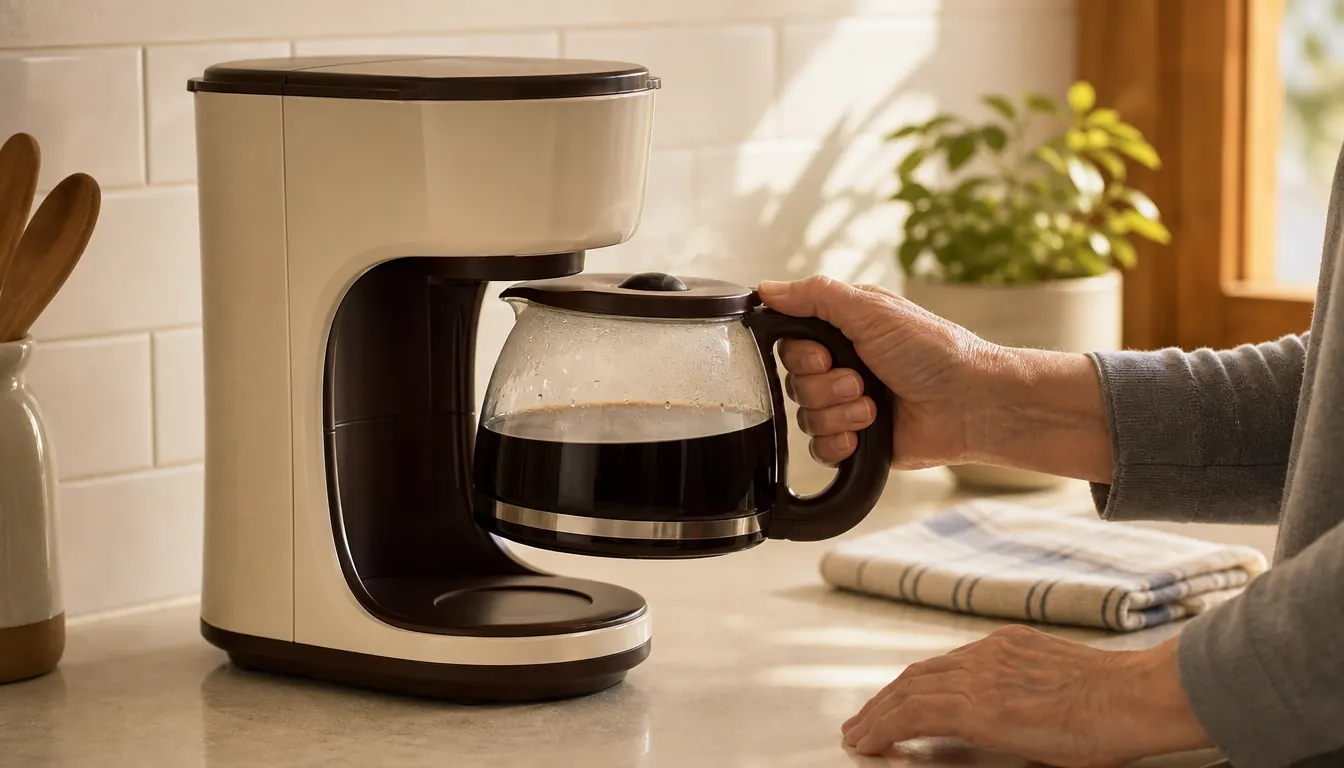
First, the reservoir. On this model you pour water in from the top, from the carafe or a pitcher, and if you pour faster than the machine wants, a little water collects at the seam near the base. I have learned to pour slowly. Two years in, it is automatic. But the first month I kept a dish towel underneath, and I still keep one nearby.
I tried filling it with a pitcher for a while, thinking the slower pour would solve it. It helped a little. What actually fixed it was stopping at the line marked on the reservoir instead of eyeballing the top. The seam still gathers a spoonful of water if I get impatient. This past spring I poured too fast while the phone was ringing and had to wipe the whole counter before I could start the machine at all. That is a two minute detour at 6:15 in the morning, and it is the closest thing to a real complaint I have.
Second, the warming plate. There are three settings, low, medium and high, and the auto-off can be set anywhere from zero to four hours. High will cook a pot if you leave it past forty minutes. I use low and I set auto-off to two hours, which is the setting that finally stopped me from forgetting about it. A friend of mine left hers on high for a whole morning and told me the last cup tasted like a penny. I believed her.
Third, the carafe. It has a dripless spout and a knuckle guard, and both are genuinely useful. The spout does not dribble down the side the way my old one did, and my hand has never once touched hot metal. But the lid and the handle together mean the carafe wants a straight set down on the plate. Do it at an angle and it will not seat right, and you will be standing there fiddling with it before you have had a cup. That is not a flaw exactly. It is a habit you build.
Fourth, and this one annoys me most. The permanent gold tone filter that comes in the box leaves a fine silt in the bottom of the carafe. It is not grit you can taste, but it clouds the last half inch of the pot. I used the included #4 paper starter filters for the first few weeks and the difference was obvious. Now I use paper most days and the gold tone filter when I have run out. That is a small ongoing purchase the listing does not lead with.
The timer has never missed a morning in two years. I could not write that sentence about the machine this one replaced.
What Actually Works
The charcoal water filter is the part I did not expect to care about. It sits inside the reservoir and I swap it on the schedule in the manual. New Hampshire water is not terrible, but it is not soft either, and the difference between a fresh filter and a tired one is real. Coffee tastes flat when it is overdue. I noticed that before I read anything about it.
I change it on the same schedule as the descaling and I mark both on the calendar above the counter. This past winter I let one go past its date by a few weeks and the coffee went flat and slightly dull, the way a pot tastes when it has been sitting too long. I put in a fresh filter and the next morning tasted like the first week I owned the machine. Nobody tells you that the filter, not the coffee, is what changes. I keep the refills in the drawer beside the paper filters, and I check that drawer before I check my list.
The heater plate settings do more than the listing suggests. Low keeps a pot drinkable for a second cup without pushing it toward burnt. Medium is fine for the first hour. High exists and I leave it alone. Combined with the auto-off range, you can set this up so it switches itself off before you have a chance to forget. In a house where one person drinks two cups and the other drinks one, that is exactly the right amount of control.
The 1200 watt element heats quickly. Cold water to finished pot takes a few minutes and the machine is not loud about it. I can be in the next room and hear it, but it does not carry through the house. In a kitchen where I am already moving around, it is background noise, not something I have to talk over.
The comfort grip handle on the carafe is worth mentioning because I pour with one hand while holding a mug with the other. A full 12 cup carafe is heavy, and the handle does not dig into my fingers. The measuring spoon that comes in the box lives in the drawer with my other spoons now, and I use it every morning. Small thing. I still notice it.
The Carafe, the Filter and the Daily Wash
Cleanup is where a coffee maker lives or dies. The carafe mouth is wide enough for my hand with a sponge, and the filter basket lifts out in one piece. Both go in the dish rack. Gary does the dishes most nights and he has never complained about this one, which is the highest praise a kitchen appliance gets in my house.
The drip tray under the basket is the part people forget. It lifts out and rinses clean, and if you leave it a week it gets a film that wants a proper wash rather than a rinse. I do it on Fridays along with the rest of the kitchen. Outside of that, this machine asks for less than anything else on my counter. The air fryer gets wiped down every single night. The coffee maker gets a rinse, a quick wipe and it is done.
The outside needs a wipe down more often than you would think. Coffee splashes when you pull the basket out a touch too fast, and a dried drip will sit there until you wipe it. It is a ten second job. I do it while the pot finishes.
One thing I would tell anyone buying this: rinse the carafe and the basket every single day, not every other day. The permanent filter holds oils, and the whole pot tastes stale by the next morning if you skip it. I learned that in the cafeteria too. A machine that gets washed daily makes better coffee a year later than a machine that gets washed weekly, and no feature on a box changes that.
What Two Years of Descaling Taught Me
I descale about every two months, which is what my water seems to want. The machine has no descaling indicator and no cleaning mode, so nothing lights up to remind you. You have to remember. I write it on the calendar above the counter, the same way I used to write the milk order on the cafeteria board.
I use white vinegar cut with water, run half the reservoir through, let it sit about twenty minutes, then finish the cycle and run two clear pots after it. The manual says something similar and I have never had a reason to change it. What I have changed is the timing. Two months is right for my water. When I stretched it to three over one busy winter, the brew slowed enough that I noticed before the pot was even half full.
The first time I let it go too long, the brew got slow and the pot ran a few ounces short. A vinegar and water cycle fixed it in one afternoon and it has brewed at the same speed since. That is upkeep, not a repair, and it is the only real maintenance this machine asks for beyond swapping filters.
Nothing on this Cuisinart has broken. Two years, one pot a day, six cups on a weekday and a full pot on Sundays. The lid still closes with the same snap. The plate still heats. That is not an exciting report, but it is a true one, and at this point in my life I am far more interested in true than exciting.
What I Liked
- The timer has never missed a morning in two years
- The 1 to 4 cup setting makes a small batch taste right instead of thin
- Three heater plate settings plus a zero to four hour auto-off
- Dripless spout and knuckle guard do exactly what they claim
- 9.61 inches tall, so it fits under standard cabinets
- Wide carafe mouth and a lift out basket that wash in seconds
Where It Falls Short
- The gold tone filter leaves silt, so I buy #4 paper filters
- No descaling reminder or cleaning mode to tell you when it is due
- Water spills at the seam near the base if you pour fast
- High heat will scorch a pot left past forty minutes
- The carafe and lid need to be set down squarely on the plate
Who This Is For
This is for the household that drinks a pot, not a cup, and wants it finished before anyone is fully awake. Two people, a timer, a schedule that repeats. It is also for anyone with a small batch problem, because the 1 to 4 cup setting is a genuine fix and not a line on a box. If you are feeding a table on Sunday, the 12 cup capacity is real and the low or medium plate holds temperature through a second round of cups.
It suits a kitchen with counter depth to spare and a cook who does not mind a ninety second wipe down each morning. In my kitchen, with eight feet of counter and a pantry closet holding everything that is not used daily, this one earned its spot and kept it.
Who Should Skip It
If you want one cup and you want it in ninety seconds, skip this. My sister Carol has a pod machine and she is happy with it. I have used hers and it makes a decent cup, and there is nothing to wash but the pod holder. What it does not do is keep a pot hot for a Sunday morning with four people wandering through the kitchen. Those are different jobs and I would not pretend otherwise.
Skip it too if you will not wash the basket daily or descale on a schedule. A machine with no cleaning indicator rewards the person who keeps a calendar and punishes the person who does not. And skip it if you refuse to buy paper filters, because the gold tone filter alone left silt in the bottom of every pot I brewed with it.
One last thing for anyone moving up from a basic maker with no timer. The first week you will fiddle with the settings more than you expect. Give it a week. By the second week the routine is invisible, and you will wonder why you put up with a cold pot for eight years.
Six cups, brewed at 6:15, without you standing there
Two years in, this is still the machine by my sink. Set it at night, set the plate to low, set auto-off to two hours, and stop thinking about it until morning.
Amazon Check Today's Price on Amazon →That is the honest picture. A few small frictions, a couple of habits to build, one box of paper filters in the cupboard, and a pot that has been ready every single morning for two years. In my kitchen, that is what earns the counter space.