

The first time my morning coffee tasted like a penny, I blamed the beans. Then I blamed Gary, who had washed the mugs the night before and maybe left soap behind. He hadn't. The problem was inside the coffee maker, and it had been building for months. I bought the Cuisinart DCC-1200 Brew Central about two years ago, and I had never descaled it.
Scale is sneaky. It does not announce itself with a light or a beep. It coats the inside of the machine, slows the brew, and makes good coffee taste flat and slightly metallic. I live in Nashua, New Hampshire, and our water is not bottled-soft. I set the Cuisinart timer at night, it brews at 6:15, and I make about six cups for the two of us. That is enough hot water through the same parts every morning to leave a film behind. Now I descale about every two months, and the coffee tastes like coffee again.
I am not a coffee snob. I spent 26 years running a school cafeteria, and I have made more pots of coffee than I can count. What I care about is that the first cup tastes the same on Tuesday as it did on Monday. A drip coffee maker is a simple tool. It needs clean water, a clean basket, and a clean path from the reservoir to the carafe. Scale breaks that path. Descaling fixes it.
Before you buy new beans, clean the machine that brews them.
The Cuisinart DCC-1200 has a permanent filter and a charcoal water filter, but neither one stops mineral scale. A bottle of white vinegar and twenty minutes will do more for the taste than a new bag of beans.
Amazon Check Today's Price on Amazon →Step 1: Decide if it is scale or something else
Start with the taste and the clock. If the coffee turns bitter or flat before the beans should have gone stale, scale is a likely suspect. In my kitchen the tip-off came on a Tuesday in February. The pot took what felt like twice as long to finish, and the coffee tasted like it had been sitting since Sunday. I had opened a fresh bag of beans the week before and blamed those beans for three mornings running. I ground them finer, then coarser, then bought a different roast. Nothing helped, because nothing was wrong with the beans. If the brew takes longer than it used to, or if the water seems to sit and sputter, that is another sign. I also look at the heater plate and the bottom of the carafe. A chalky white ring means business.
Do not confuse scale with a weak recipe. If the coffee is thin but the machine runs at the same speed, try more coffee or a finer grind before you drag out the vinegar. If the machine is slow and the coffee is harsh, descale. The Cuisinart has a 12-cup capacity, but I only brew about six cups most mornings. Small batches can hide scale because there is less water to move through the lines. The taste is still the first clue.
I mark it on the calendar, about every two months. Two years of daily brewing has taught me that waiting for a problem costs more time than preventing one. If you have hard water, you may need to do it more often. If your water is soft, you can stretch it. The machine does not care about the calendar. Your tongue does.
Step 2: Mix the vinegar and water
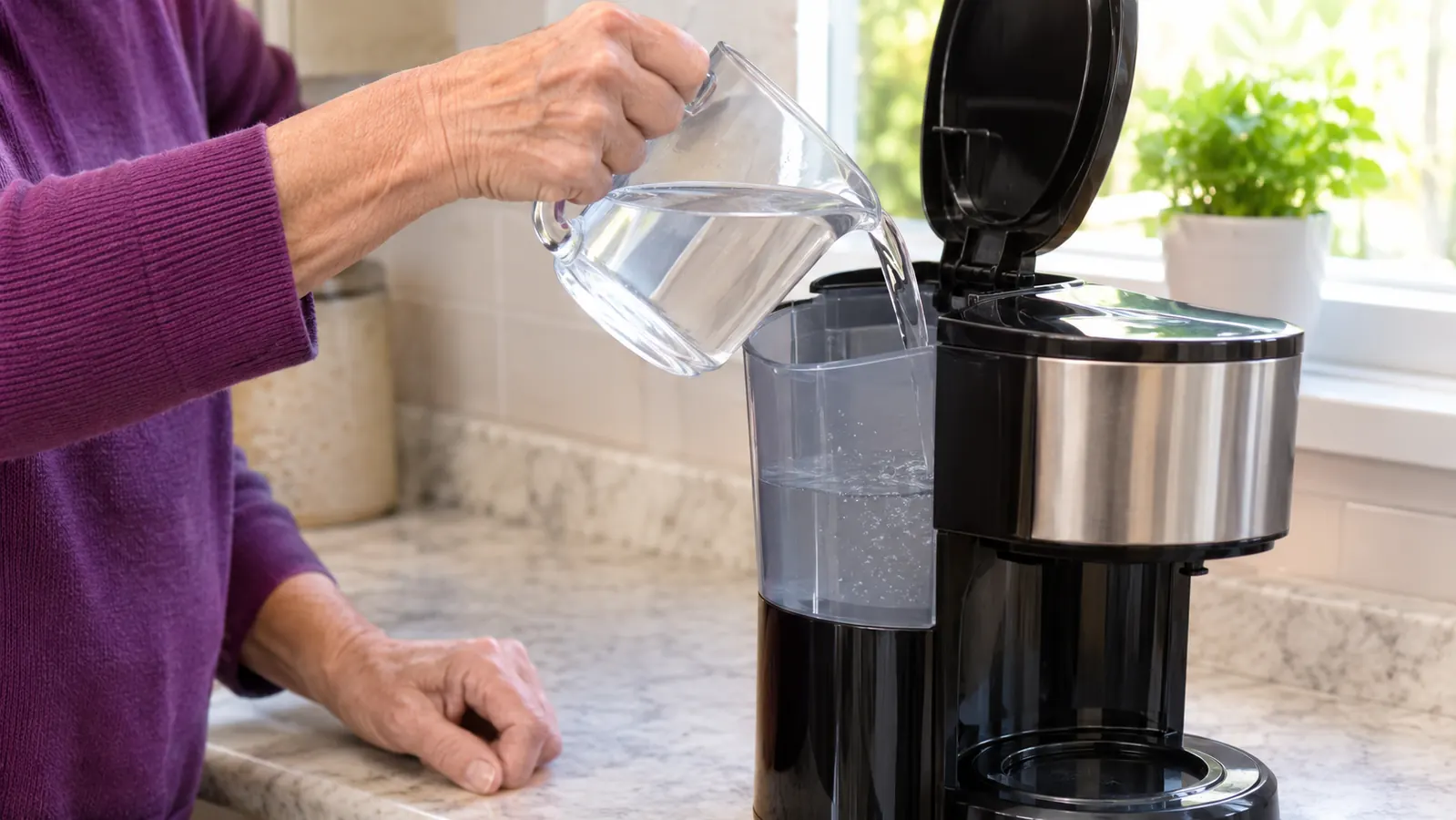
Mix equal parts plain white vinegar and cool water. I use the cheap white vinegar from the grocery aisle, not apple cider vinegar and not cleaning vinegar. I do not own a measuring pitcher that fits under the tap, so I fill the carafe halfway with cool water, pour that into the reservoir, then fill the same carafe halfway with vinegar and pour that in behind it. Two carafe halves, one of water and one of vinegar, gets me close enough to even. Take out the charcoal water filter and set it aside. I do not want vinegar sitting in it. Put the carafe in place, leave the filter basket empty, and skip the coffee.
The Cuisinart has a permanent filter, but for this job I use no filter at all. The vinegar needs to move through the empty basket and into the carafe. The handle and the dripless spout make the carafe easy to move without sloshing. I set the carafe on the counter next to the sink and keep a towel under it. Vinegar smell travels. Open a window before you start.
Do not fill past the top line. The machine is not a bucket. If you have a smaller model or you are not sure, use less liquid and run the cycle twice. The point is contact time, not volume. More vinegar does not make the job faster. It just makes the kitchen smell like a salad dressing factory.
Step 3: Run it halfway and let it sit
Start the brew like you normally would. Let it run until the carafe is about half full, then unplug the machine. The first time I tried this I waited too long and the reservoir was nearly empty before I got the cord out of the wall, which meant the vinegar barely touched the upper lines. Now I stand there and watch it. It takes three or four minutes. I do not let the whole reservoir run through at once. The vinegar needs time to sit on the scale and soften it. I leave it for twenty to thirty minutes. Sometimes I leave it longer if I get busy with the mail or the phone.
Plug the machine back in and let the rest of the vinegar mix run through. The carafe will be warm, and the heater plate will be warm too. Use a dry towel or an oven mitt if you need to move it. I empty the carafe into the sink and rinse it right away. Do not taste it. It is vinegar and warm water, and it will not tell you anything useful.
If the brew is still slow after the vinegar cycle, do it again. Some machines need another round, especially if they have gone a long time without attention. I have not needed a repeat on the Cuisinart, but I also do not wait until the coffee tastes like a battery. Two years of regular descaling has kept it simple.
Scale does not announce itself. It slows the brew, flattens the taste, and makes you blame the beans.
Step 4: Rinse until the vinegar is gone
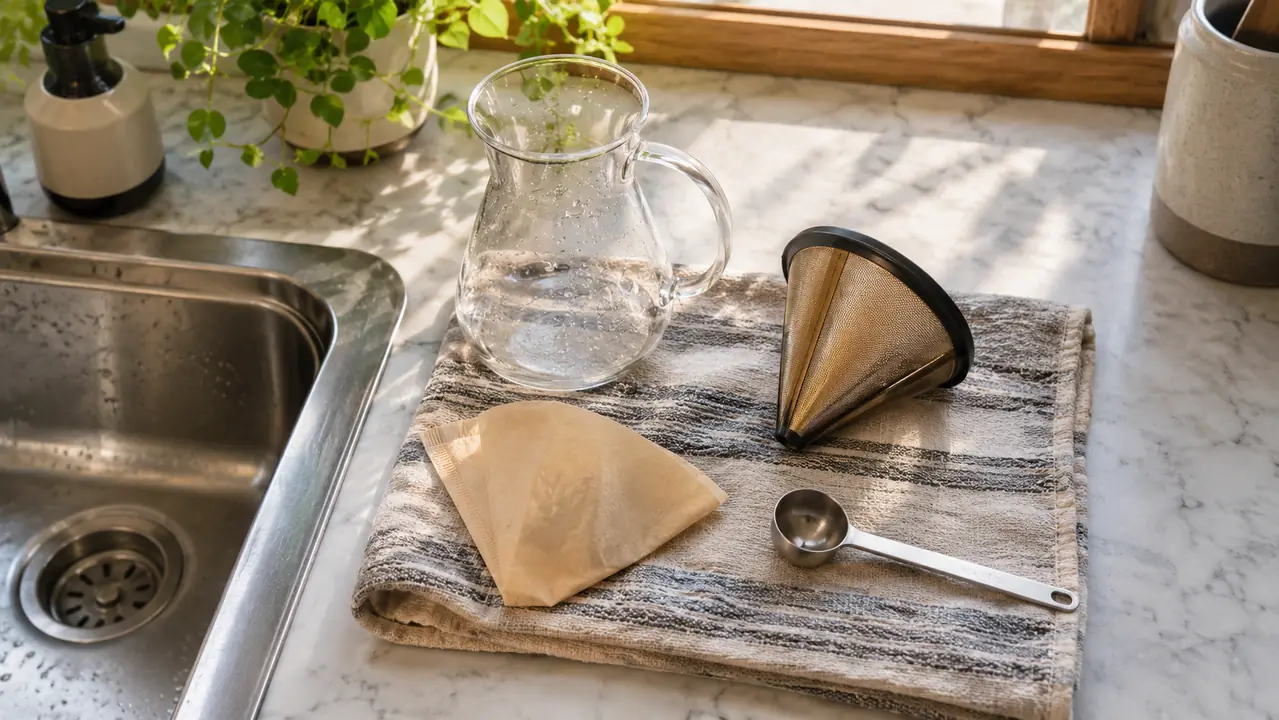
Fill the reservoir with clean water and run a full cycle with no coffee and no vinegar. Empty the carafe. Do it again. I keep running clean water through until the vinegar smell is gone, then I run another cycle for good measure. The first cycle will still smell sharp. The next will be better. Another is usually clean.
While the water runs, wash the carafe, the lid, the permanent filter, and the measuring spoon in warm soapy water. Use a soft cloth, not steel wool. Rinse everything well. The outside of the machine gets a damp cloth, especially around the handle and the knuckle guard where fingers land. Do not dunk the base in water. That is a quick way to turn a coffee maker into a counter decoration.
Put the charcoal water filter back in. If it has been in there for months, replace it. A charcoal filter helps with taste and odor, but it does not remove the minerals that cause scale. That is why descaling and filter changes are two different jobs. One keeps the coffee tasting clean. The other keeps the machine running at speed. I do both.
Step 5: Make a test pot and set the timer
Reassemble everything and run a small pot of coffee with the 1-4 cup setting. This is my test batch. If the coffee tastes like vinegar, run more clean water through it. If it tastes flat, check the beans. If it tastes like coffee, you are done. I use the 1-4 cup setting because it heats a smaller amount of water and does not leave me with a full carafe I have to dump. The first time I descaled, my test pot still had a faint sharp note at the back of the throat, so I ran two more plain water cycles before I trusted it. Three cycles of clean water is my rule now, and I have not tasted vinegar since.
Set the timer for the morning if you use it. I set mine at night for 6:15, same as always. The 24-hour programmability is the reason I bought this model in the first place. The auto-off can be set from 0 to 4 hours, and I keep it on the shorter end because I do not like coffee cooking on the heater plate. The variable heater plate has low, medium, and high. I use low after the brew finishes.
Wipe the counter and put the vinegar bottle away. The whole job takes about an hour, but most of that is waiting. I do it on a morning when I am already in the kitchen, not on a Sunday when the grandkids are coming. The machine is ready by lunch. The next morning, the coffee tastes like it did when the machine was new.
What Else Helps
Use the charcoal water filter and change it. It will not stop scale, but it helps with chlorine and old-pipe taste. I also keep #4 paper filters in the pantry. The permanent filter is fine for everyday, but paper catches the fine dust that can make a pot taste muddy. I use paper when I am making coffee for company and the permanent filter on regular mornings. The little measuring spoon that came in the box lives in the same drawer as the filters, one level scoop per cup on the days I am being careful and a heaped scoop when Gary has a long day ahead of him. Two years in, I still use the spoon that came with the machine.
Do not let coffee sit on the heater plate for hours. The auto-off is there for a reason. I set it short and pour the rest into a thermos if I have extra. A clean carafe matters too. A thin film of old coffee oil will ruin a fresh pot faster than people think. Wash the carafe with hot soapy water, rinse it well, and leave it to air dry with the lid off.
If you have hard water, descale more often than I do. If you have soft water, you can stretch it. The machine will tell you with taste and speed, not with a light. The Cuisinart DCC-1200 has been on my counter for two years, and it has earned its spot. It is not fancy. It just makes a pot of coffee and keeps doing it. That is what I want from a machine at 6:15 in the morning.
One more habit that helps: rinse the filter basket after every pot. Grounds and oils build up in the corners, and that stale smell can make fresh coffee taste older than it is. It takes ten seconds. I do it while the last of the coffee is still dripping into the carafe. Gary does the dishes most nights, but this is one thing I handle because I am the one standing there waiting for the first cup.
A clean machine makes better coffee than a new bag of beans.
If your drip coffee maker has lost its edge, start with a descaling. The Cuisinart DCC-1200 has a permanent filter, a charcoal water filter, and a heater plate that benefits from a little attention. Today's price is on the listing, and the vinegar is already in your pantry.
Amazon Check Today's Price on Amazon →