
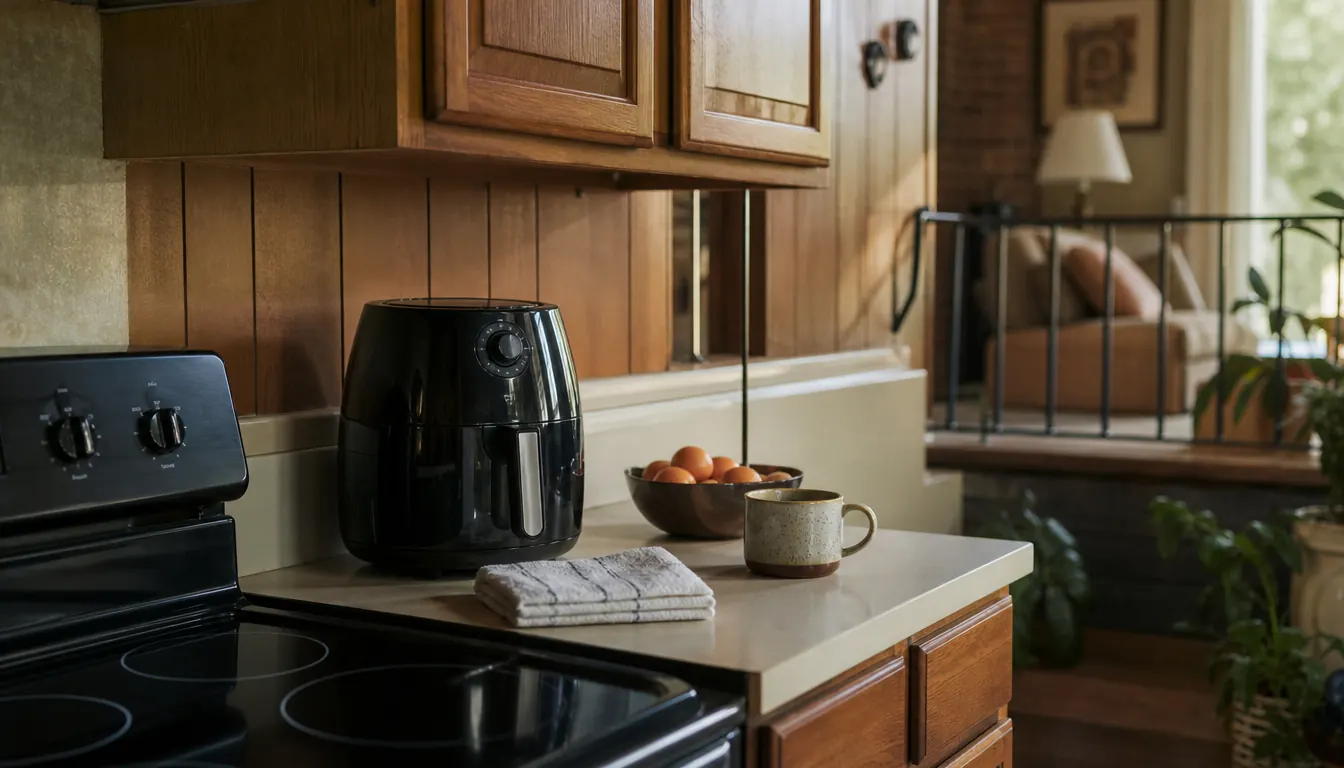
I bought the Ninja AF101 in early March with my own money, from Amazon, the way I buy everything else in my kitchen. Eight months later it still lives on the counter to the left of my range, and I have a running list of small complaints that never made it into the listing. That combination, the fact that it stayed and the fact that it still irritates me some nights, is the whole review.
Here is the short version. It crisps chicken thighs and salmon better than my wall oven ever did, and it does it without turning the kitchen into a sauna for the rest of the evening. It also holds exactly dinner for two and not a thigh more. If you are feeding four people at one sitting you will be running batches, and if you want to load a basket and walk away for forty minutes, this is not that machine.
The Quick Verdict
Crisps dinner for two faster than my wall oven comes up to heat, and the basket rinses clean in about four minutes. The small capacity and a loud fan are the trade. I would buy it again.
Amazon Check Today's Price →Eight months in, it is still the appliance on my counter
The 4-quart Ninja AF101 does dinner for two, then rinses clean while the plates are still on the table. Measure the height under your cabinet first, then look at the current price.
Amazon Check Today's Price on Amazon →How I've Used It for Eight Months
I am sixty four and retired after twenty six years running a school cafeteria, so I have cooked on equipment built for a few hundred people and on equipment built for two. Before March I had no air fryer at all. I crisped things in the wall oven, which meant heating a big box so I could brown one pound of chicken, and then sitting in a kitchen that stayed warm for an hour afterward.
The Ninja arrived in early March and went on the counter to the left of the range. It has not moved since. It is plugged in all the time, which is not how I run my kitchen. Most of my appliances live in the pantry closet and come out when they are needed. This one earned the counter and it kept it.
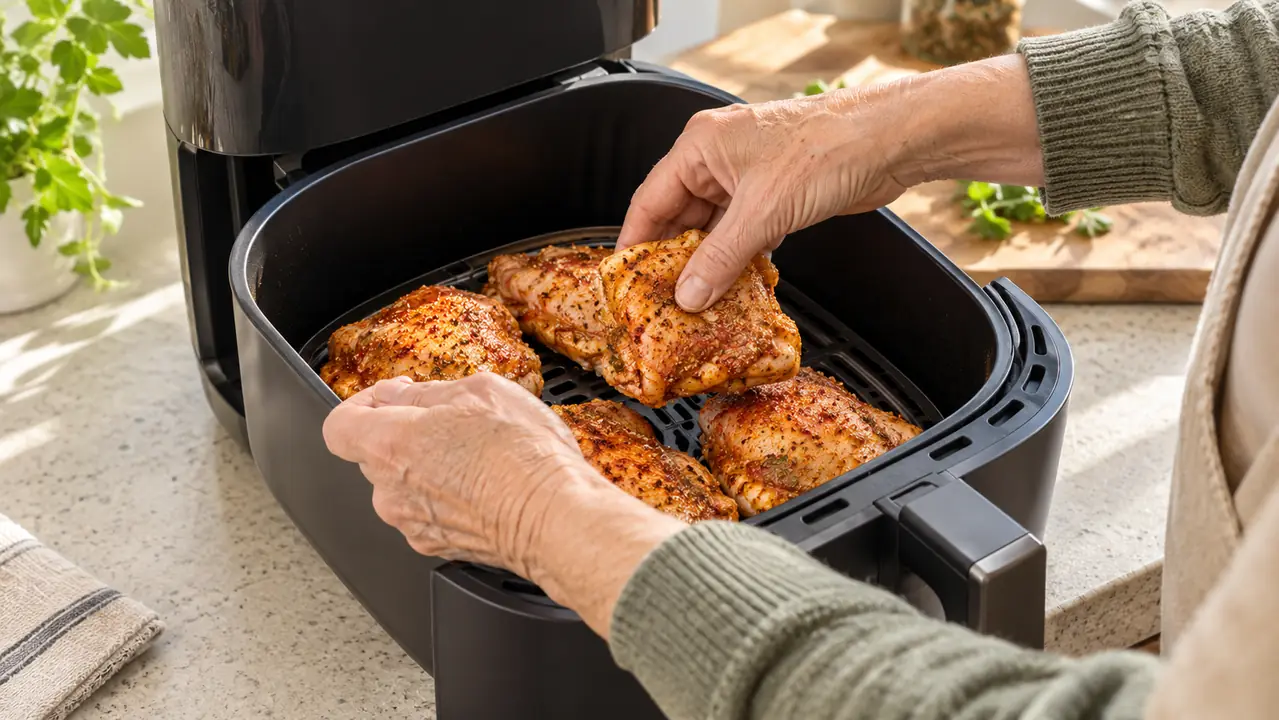
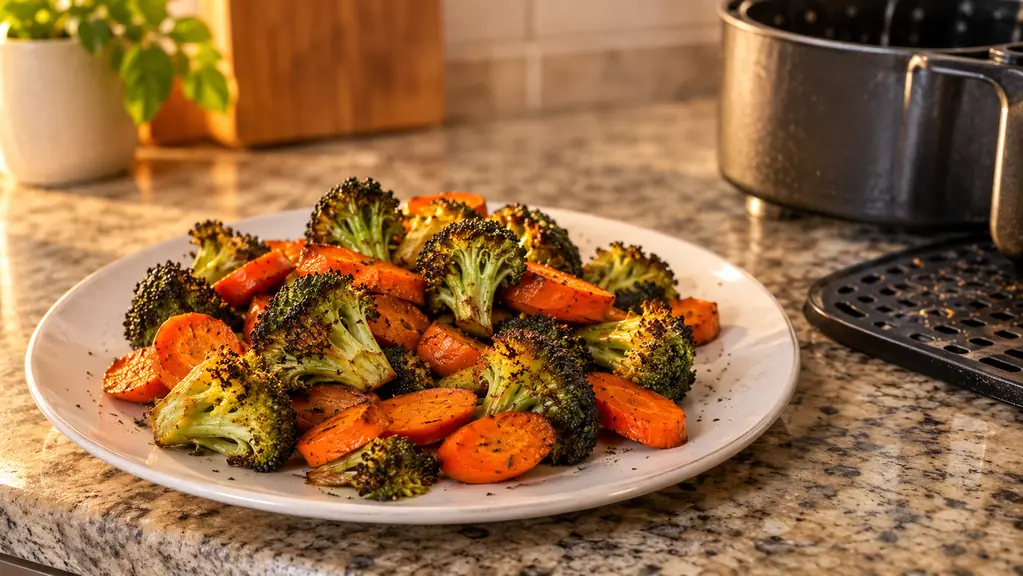
I use it three or four nights a week. Chicken thighs, salmon fillets, broccoli and carrots, frozen fries when the grandkids are here, and leftovers that need to come back to something like their first life. Gary does the dishes most nights and he has a short list of pans he resents, so four minutes of cleanup matters more in this house than it sounds.
The basket holds dinner for two. That is my honest measurement, not a number off a listing. A protein and a vegetable fit without stacking. If I pile food in, it steams instead of crisping, and then the whole reason for owning the machine disappears.
The first two weeks were a series of small lessons. Green beans need to be dry before they go in or they steam. Broccoli wants a little oil and a little room. Bone-in chicken thighs need longer than I expected the first time. None of that is written on the box and all of it is obvious once you have done it twice.
Gary uses it more than I expected. He reheats a piece of leftover chicken on a Saturday afternoon rather than standing over the stove, and he has never once asked me how the panel works, which tells you how simple the panel is.
The Four Programs, and the One I Barely Touch
The Ninja AF101 runs four programs: Air Fry, Roast, Reheat and Dehydrate. The temperature goes from 105 degrees up to 400, and everything is set on a touch panel across the front. There is no dial to turn and nothing to assemble beyond washing the basket and the crisper plate before the first use.
Air Fry is the program I bought it for and the one I use most. Chicken thighs at 400 come out with the skin crackled and the fat rendered and the inside still where it should be. Salmon I pull a little early and let it sit, because it keeps cooking on the plate whether or not you are ready. Frozen fries for the grandkids are the easiest thing the machine does.
Roast I use for vegetables and for a small pork tenderloin. In practice Roast and Air Fry behave close enough that I choose by habit, not by any rule I could explain to you. Reheat is the program nobody mentions and the one that surprised me most. Leftover roast chicken comes back moist instead of leathery, and a slice of pizza from Friday is better on Saturday than it was on Friday.
Dehydrate is the one I barely touch. The low fan speed and the low temperature are what pull the moisture out of food, and that works. I did apple slices once and they came out the way they should. But it runs for hours, and I do not have the patience for it more than once a season. If drying food is your main reason for buying, look at a dedicated dehydrator first.
The box includes a 20 recipe booklet, and I read it the way I read any manual, which is to say I looked at the temperatures and ignored the rest. Seeing 105 at the low end and 400 at the high end told me more about what the machine could do than any of the recipes did.
The touch panel took me two days to stop thinking about. Four programs, a temperature you nudge up or down, and that is the surface of it. I have never pressed something by accident reaching over it, and I have never had to get the booklet out to remember how it works. For a sixty four year old who does not want a second computer in the kitchen, that counts for something.
The Counter Space Reality
Here is where the honest part starts. The unit measures 13.6 inches deep, 11 inches wide and 13.3 inches tall, and it weighs 10.6 pounds. My kitchen gives me about eight feet of usable counter, one sink, an electric range and one wall oven. Eight feet sounds generous until the coffee maker and the knife block and the bowl of fruit take their share.
The Ninja sits to the left of the range, under the upper cabinet, with a couple of inches behind it because the fan has to push hot air somewhere. That clearance is the thing I would tell anyone standing in my kitchen. Measure the height under your cabinet before you decide. I got lucky. A taller machine would not have fit where I wanted it, and then it would have lived in the pantry and been used half as often.
At 10.6 pounds I can lift it one handed, which matters on the nights I want to wipe under it. I do not carry it around. It stays where it is and the food comes to it, and after eight months that still feels like the right arrangement.
It has not moved off my counter since March, and in a kitchen with eight feet of workspace, that is the only review that counts.
Cleanup Is the Part Nobody Reviews
The basket and the crisper plate are ceramic coated and nonstick, and both are dishwasher safe. Most nights I rinse them by hand anyway, because it takes about four minutes and the dishwasher is already full of plates. Waiting for a full load is how a nonstick basket ends up with a scrubbing problem it did not need to have.
The crisper plate is the part with the grooves, and the grooves are where a piece of chicken skin hides if you are in a hurry. A sponge with a rough side gets it in one pass. What I do not do is leave it until morning. Nonstick forgives a lot and does not forgive a dry crust that sat all night.
The inside of the unit wants a wipe every week or so. I unplug it, let it cool down and go over the ceiling and walls with a damp cloth. Grease that builds up in there will smoke the next time you run it at 400, and then you will decide the machine is failing when it is only dirty.
What Is Genuinely Annoying
The capacity is the first annoyance and it is not minor. Four quarts is dinner for two. My two daughters and their families come for Sunday dinner about twice a month, and on those nights I run two batches. Two batches means the first one waits on a plate under foil while the second one cooks, and the first one is never quite as good as the second.
The fan is the second. This is not a quiet machine. When it is running the kitchen is loud enough that I raise my voice to ask Gary a question, and the sound carries into the next room. I have gotten used to it. A guest has not, and one of my daughters asked me whether it was supposed to sound like that.
The third is the learning curve, and this is what I would most want somebody to tell me. An air fryer at 400 is not an oven at 400. My first batch of frozen fries came out darker than I wanted because I used the time I was used to from the oven. Take three or four minutes off whatever you would do in the oven and check early until you know your machine.
The basket is also the reason I stopped cooking a whole chicken in it. A four pound bird does not fit, and I mention it because two people who roast a chicken most Sundays will assume a machine this size can manage it. Thighs, yes. A whole bird, no.
The last one is smaller. The outside of the unit gets warm during a long run, warm enough that I keep the dish towel off the top of it and would not want a small hand reaching up to it. That is what 1550 watts of convection heat in a small box does. It is normal and it is still worth knowing before a grandkid wanders in.
How It Compares to the 5-Quart My Daughter Owns
My daughter Karen has a 5 quart air fryer, and I have cooked in her kitchen enough to know the difference. The bigger basket is genuinely easier on a night when you are feeding three or four. Food goes in one layer, nothing waits under foil, and the whole dinner lands at once.
What I noticed is that the bigger one takes up more counter, and Karen has more counter than I do. The capacity question is really a counter question and a people question. Four quarts fits my kitchen and my table. Her basket would not fit my eight feet of workspace, and I would not want to lift it out of the cabinet twice a week. Neither of us is wrong.
What It Replaced, and What It Did Not
The wall oven is still there and I still use it for a Sunday roast or anything that needs a wide pan. What changed is the weeknights. A chicken thigh dinner used to mean fifteen minutes of preheating a big oven and then a kitchen that stayed warm for an hour. The Ninja heats fast, does the job and leaves the room alone. On a hot night in July that was the difference between cooking and ordering out.
What it did not replace is my Instant Pot for beans and stock, the toaster, or the wall oven at Thanksgiving. I am not going to pretend one appliance took over my kitchen. It took over one job, the job of making something crisp for two people without heating a whole oven, and it does that well enough that I stopped thinking about it months ago.
What I Liked
- Crisps chicken thighs and vegetables without heating the whole kitchen
- Basket and crisper plate are dishwasher safe and rinse clean in about four minutes
- Four programs and a 105 to 400 degree range cover more than frying
- Reheat brings leftover roast chicken back moist instead of leathery
- 10.6 pounds, so it lifts and wipes under without a fight
Where It Falls Short
- 4 quarts holds dinner for two, so company means two batches
- The fan is loud enough to stop a conversation
- Air fryer temperatures run hotter than oven temperatures and the first batch will teach you that
- The outside of the unit gets warm during a long run
- A whole chicken will not fit, which surprises people who roast on Sundays
Who This Is For
This is for a household of one or two people who want crisp food without turning on the oven, and for a kitchen where counter space is tight enough that every appliance has to justify itself. It is also for someone who will spend the first two weeks paying attention, checking the basket early and learning how their machine runs, because that is what it takes to get a good result here. If you cook a protein and a vegetable three or four nights a week the way I do, the rhythm fits.
It is also the right size for a Sunday batch of something you plan to freeze. I do chicken thighs in two rounds on a Sunday, cool them, and put them in the freezer for weeknights when I do not want to think. A bigger machine would do it in one round and I would still have to cool and pack the same amount of food.
Who Should Skip It
Skip it if you regularly cook for four or more. The math does not work, and two batches every night turns a convenience into a chore. Skip it if you want to fill a basket, press a button and walk away, because you still have to check and turn things. Skip it if dehydration is a real hobby rather than a curious afternoon, or if noise in an open kitchen bothers you, or if the height under your cabinets will not take a 13.3 inch machine. None of those are failures of the product. They are the wrong fit.
The small machine that stopped me heating the oven for two people
Eight months, three or four nights a week, and it still earns its spot on the counter. Measure your cabinet height first, then go look at the current price.
Amazon See the Ninja AF101 on Amazon →