
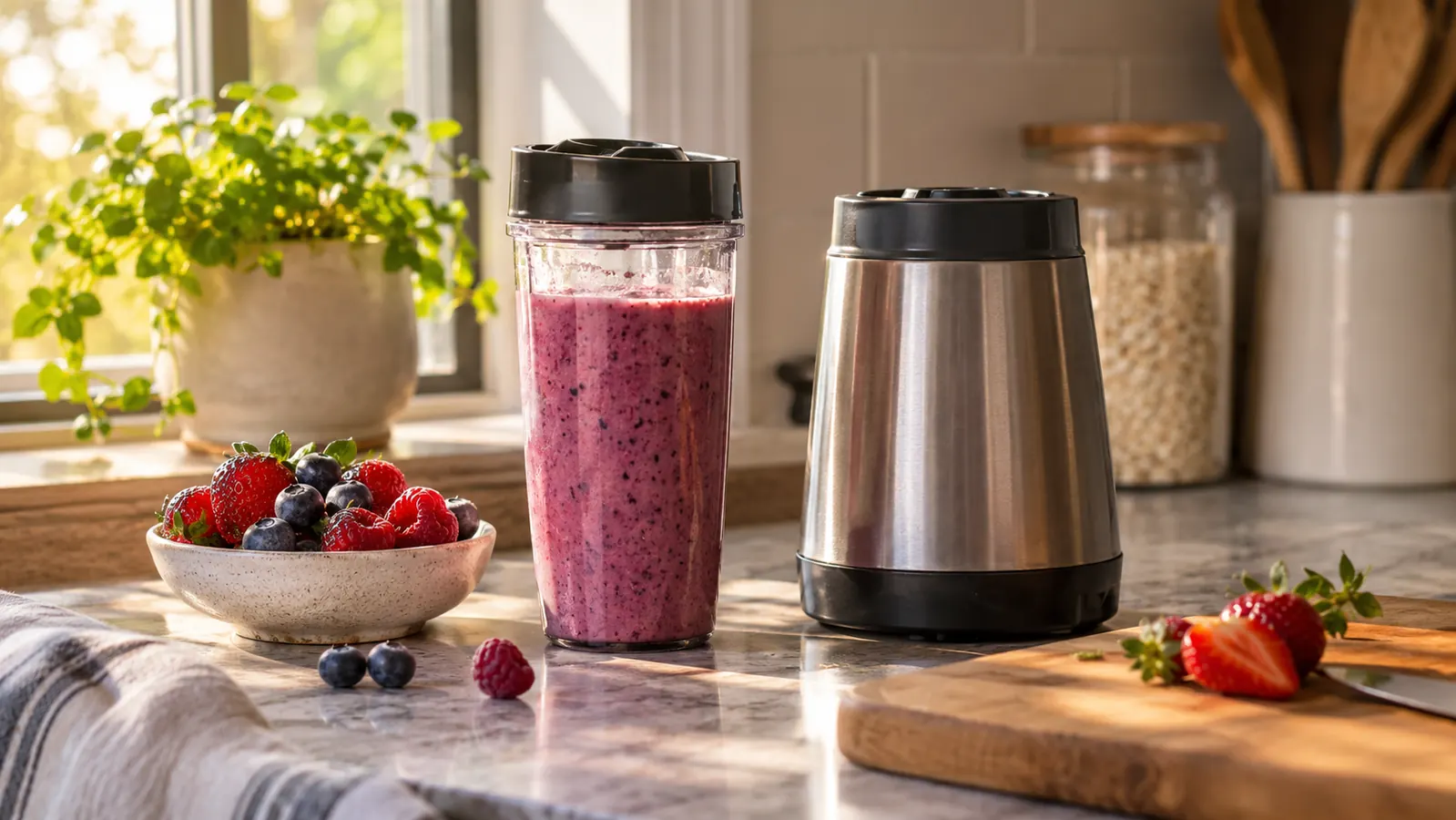
The Ninja Fit came home with me in May and it has not spent a single night on my counter since. That is not a complaint. My kitchen gives me about eight feet of usable counter, one sink, an electric range and a wall oven, and I have a standing rule that anything staying out has to earn that space every day. This thing is 4.3 inches wide, 13 inches tall and 3.1 pounds. It tucks into a cupboard without a fight, and it still comes out several mornings a week. For a small appliance in a small kitchen, that is the whole ballgame.
Before May I owned no blender at all. I spent twenty-six years running a school cafeteria, where the equipment was commercial and somebody else's job to move, and at home I had my oven and my pots and never felt the lack. What changed was Gary. He is 66 now, retired from the mail, and he does the dishes most nights, which means I think hard about how many parts a thing has before I carry it through the door. He wanted a fruit smoothie in the morning. So this is one Ninja Fit, two people, six months, and an honest accounting of what it does and what it will not do.
The Quick Verdict
700 watts, two 16-ounce cups, and a push-to-blend base about the size of a coffee mug. It handles smoothies, dressings and small batches of pesto well. It gets stubborn with anything thick, and it will not feed a crowd.
Amazon Check Today's Price →Six months in, it still gets used more often than my toaster
Two 16-ounce cups, a 700-watt motor, and a base that takes up less room than a dinner plate. If your counter is tight and your mornings are rushed, this is the shape of blender that actually gets used instead of stored.
Amazon Check Today's Price on Amazon →How I've Used It
I bought it in May with my own money, off Amazon, the same as everything else in this kitchen. Nobody sent it to me and nobody asked me to write this. It lives in the cupboard below the microwave, next to the flour canister, and it comes out four or five mornings a week, sometimes more. Gary takes his smoothie at the table with the newspaper. I have my coffee.
The morning job is frozen fruit and a splash of juice, sometimes half a banana, sometimes a spoon of yogurt. Beyond that, it does salad dressing two or three times a week, which I did in a jar with a lid for thirty years and got tired of shaking. It does pesto in the summer when the basil is coming in faster than I can use it. It has done a batch of breadcrumbs from stale heels, and it has done a marinade when I did not want to dirty a bowl and a whisk. That is the honest list. It is not a soup machine and I have never once put anything hot in it, and I do not intend to start.
The first week I got the proportions wrong. I filled the cup most of the way with frozen berries and added barely any liquid, and the blade spun a hole down the middle and left the rest as a frozen plug. I had to stop, take the cup off, shake it, and press again, twice. Now I put the juice and the yogurt in first, then the fruit on top, and I do not fill past the line on the cup. That one change fixed almost every complaint I had in the first two weeks.
What it replaced is nothing, which matters. A lot of appliances replace something you already had and then argue with it. This one filled a hole. There was no blender before, so there is no comparison to draw except the one I can make from my daughter Lisa's kitchen, where a Magic Bullet has lived on her counter for years. I have used hers. I will get to the differences, but I want to be clear that I did not switch to this from anything.
What Push-to-Blend Is Actually Like
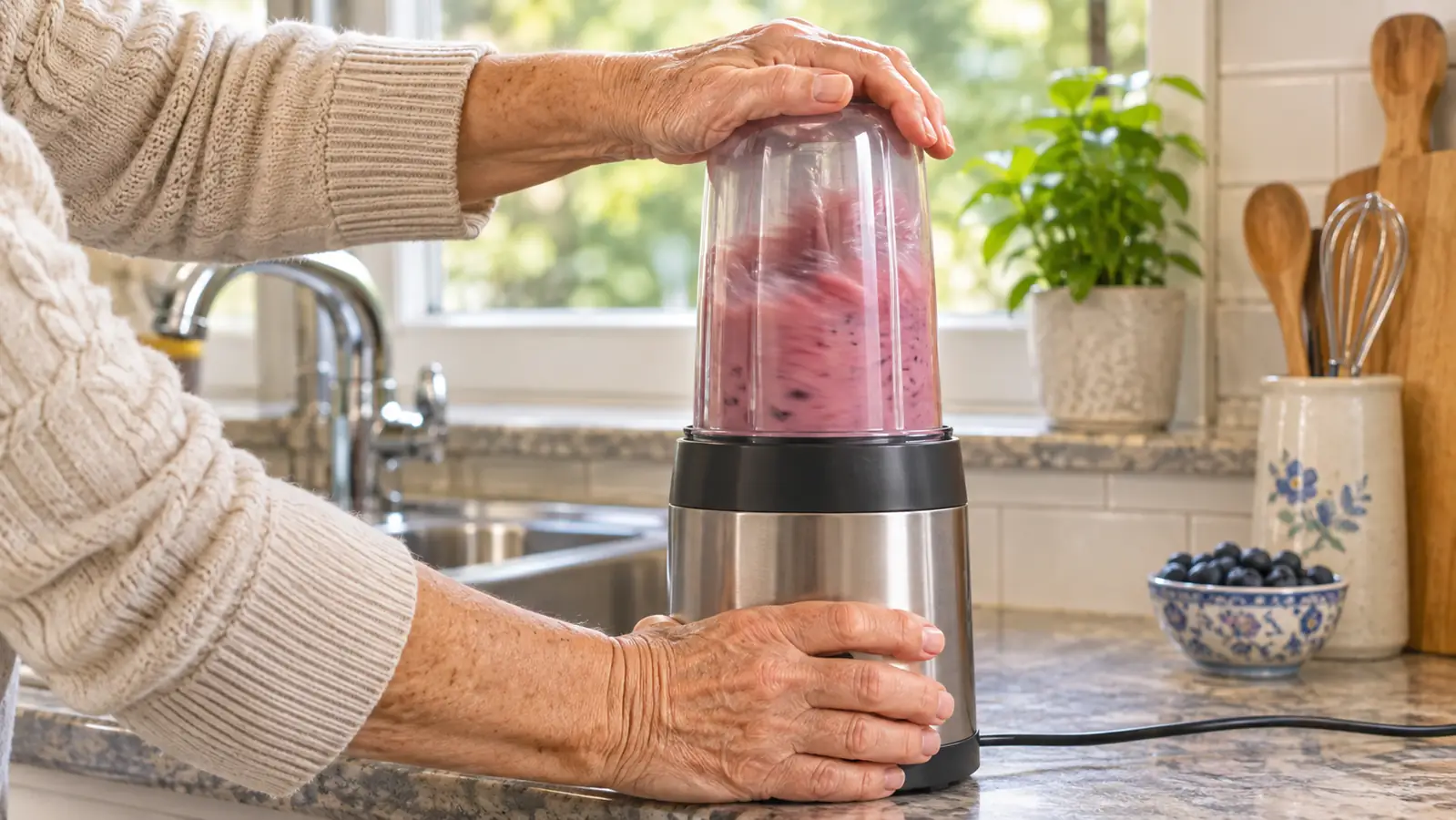
There are no buttons. You fill a cup, twist on the blade assembly, turn it upside down and press it down onto the base. It runs while you hold it. Let up and it stops. That is the entire control scheme, and the listing calls the control type push, which is accurate to the letter. If you have ever used a countertop appliance with eleven buttons and a menu you never learned, the relief here is real. Nothing to program. Nothing to forget.
The box gives you two 16-ounce cups, a pour spout, and a small recipe guide. Two cups sounds like a throwaway detail until you have lived with one. One cup means you wash between jobs. Two means you make Gary's smoothie, set his cup aside, and run the dressing in the second cup without stopping to wash anything. That is not a marketing point, it is the reason this thing gets used on a Tuesday instead of only on a Sunday. The pour spout is the other quiet thing I have come to appreciate. Dressing goes from the cup into the jar without a funnel and without a spill down the front of the jar.
The cups are plastic and BPA free. They are light. They do not feel like something you would hand down to a grandchild, but they have been through six months of near-daily washing in my sink and a run through the dishwasher most weeks, and they are not scratched up the way I expected. The base wipes clean with a damp cloth. There is no crevice I have had to go after with a brush, which is more than I can say for the hand mixer I have owned for four years.
One thing I did not expect: the base is small enough that I can set it on the counter, run a cup, and put it back in the cupboard without moving anything else. In a kitchen where the coffee maker and the toaster already have their spots, an appliance that does not require rearranging the counter is an appliance that gets used on a Wednesday.
Smoothies, Dressings and Pesto: What It Handles Well
Frozen fruit is the test that matters, and it passes. Frozen strawberries, frozen blueberries, a chunk of frozen banana, and it comes out smooth in under a minute with a couple of pauses to shake the cup. Ice is listed among the recommended uses and I have crushed it for a pitcher of tea without trouble, though I do it in small amounts and I do not push it. The 700 watts does the work and the motor does not sound like it is straining to prove something.
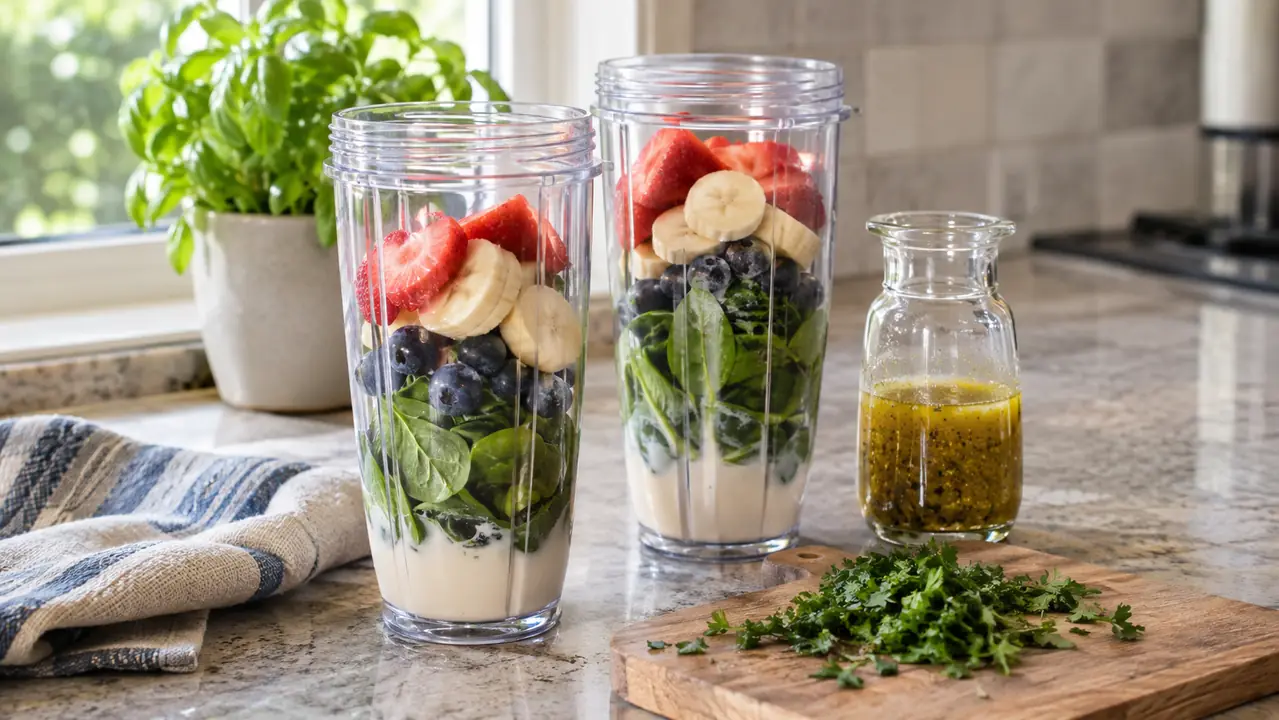
Vinaigrette is where it surprised me. Oil and vinegar and mustard and a shallot, twenty seconds, and it holds an emulsion long enough to get the salad on the table. My old jar method separated before the plates were down. I have also done a thicker blue cheese dressing, and that one needed a scrape down and a second run, which is the pattern you should expect from a cup this size.
Late in September, with the last tomatoes from the garden on the counter, I made a dressing with one tomato, a splash of red wine vinegar, a shallot and oil, and it went into the jar in one run with no scraping. That is the sort of small job this machine was built for. It was never built for a quart of soup.
Pesto is a small batch job and it does it well as long as I work in stages. Basil and oil and garlic first, then the nuts and cheese, then a scrape and a final pulse. If I dump everything in at once and press, the leaves at the top just spin. That is not a flaw in the machine so much as physics in a 16-ounce cup, and once I adjusted how I load it, the results stopped disappointing me.
Two cups in the box is the difference between a gadget and a tool. One cup means you wash between jobs. Two means you do not.
Where the Ninja Fit Fights You
Thick mixtures are the weak spot. Peanut butter, a stiff hummus, a heavy date and nut paste, anything that does not want to move. The blade spins and the mixture sits against the wall of the cup and you stop, take the cup off, shake it, scrape it with a spatula, and press again. You will do this three or four times. It works in the end, but a machine with a tamper and a wider jar does it in one pass, and I know that because I have watched the commercial ones do it for twenty-six years.
Capacity is the other honest limit. Sixteen ounces is one good serving. When the girls and the grandkids come on a Sunday and I want a smoothie for four, I am running two cups and doing it twice, and the second batch waits. For two people on a weekday morning that is fine. For a family of five at breakfast it is not the right tool, and I would rather say so now than have you find out on a school morning.
It is loud. Not unbearable, but you will not have a conversation over it, and if Gary is still asleep when I start it at 6:40 on a Saturday, he knows about it. It is a 700-watt motor turning a blade inside a plastic cup, and there is no housing around it to soak up the sound. Set your expectations there and it will not bother you.
What Six Months of Washing Did to It
Nothing has broken. Nothing has cracked. The blade assembly still seats with a firm twist and still comes apart for washing, and the base still starts on the first press every time. The only cosmetic wear is on the outside of the cups where they meet the counter, and you have to hold one up to the window to see it. It carries a one year limited warranty, and based on six months I do not expect to need it, but I also would not expect this to be the appliance I am still using in fifteen years. It is plastic and it is light and it cost what a small appliance costs.
Cleaning is the part that decides whether a small appliance lives or dies in my house. Fill the cup with warm water and a drop of soap, press it for ten seconds, rinse, done. Gary does the dishes most nights and he has never once complained about this one, which is the highest praise I can offer an appliance with a blade in it. The hand mixer, for the record, he complains about.
I should also say the base has not slid around on my counter once in six months, even with my hand pressing a cup down onto it every morning. The hand mixer I have owned for four years walks across the same counter and I have to chase it. Small thing. It matters at 6:40 in the morning.
What I Liked
- Small enough to live in a cupboard: 4.3 inches wide, 13 inches tall, 3.1 pounds
- Two 16-ounce cups in the box, so you can run a smoothie and a dressing back to back
- Push-to-blend means no buttons, no programming, nothing to relearn
- Handles frozen fruit, ice and vinaigrette without straining
- Rinses clean in about fifteen seconds, which is why it gets used
- Pour spout sends dressing straight into the jar
Where It Falls Short
- Thick mixtures like nut butter need repeated scraping and re-pressing
- 16 ounces is one serving, so a family breakfast means two rounds
- Loud enough that you will wake the house on a quiet morning
- Plastic cups will not last like glass or a metal jar
- Not for hot ingredients, so it is a cold-kitchen tool only
Who This Is For
This is for the person with a small kitchen and a short morning. If your counter is already at war with your coffee maker and your toaster, and you have been putting off a blender because the last one you owned was a heavy pitcher that lived in a cabinet and got used twice a year, this is the version that survives. It is small enough to keep in a cupboard and light enough that taking it out is not a chore, and that combination is what separates an appliance you own from an appliance you use.
It is also for the cook who does small jobs. A dressing. A pesto. Breadcrumbs from the heels of a loaf. A marinade. If you have ever skipped a recipe because it meant getting out a full-size blender and washing it after, this removes that excuse. And it is for a household of one or two, where sixteen ounces is a serving and not a compromise.
Who Should Skip It
Skip it if you are making smoothies for four every morning. You will be running batches and stacking cups and it will wear on you by the second week. Skip it if you want to make soup, because this is not that machine and I would not push it there. Skip it if you make a lot of nut butter or thick dips, since the scraping will drive you back to a food processor. And skip it if you want one appliance that does everything, because no small blender is that, and this one does not pretend to be.
I would also tell you to think about the cupboard. If you have a deep drawer or a shelf at hip height where this can live without being buried behind the sheet pans, it will get used. If it has to go on the top shelf behind the roasting pan, it will not, and that is true of every small appliance I have ever owned. The machine is good. Whether it becomes a habit depends on where you put it.
The blender that earns a cupboard shelf instead of a countertop throne
700 watts, two 16-ounce cups, push-to-blend, and a footprint of 4.3 inches square. Six months of near-daily use and it still starts on the first press. If a small kitchen has been keeping you out of a blender, this is the one that fits.
Amazon Check Today's Price on Amazon →