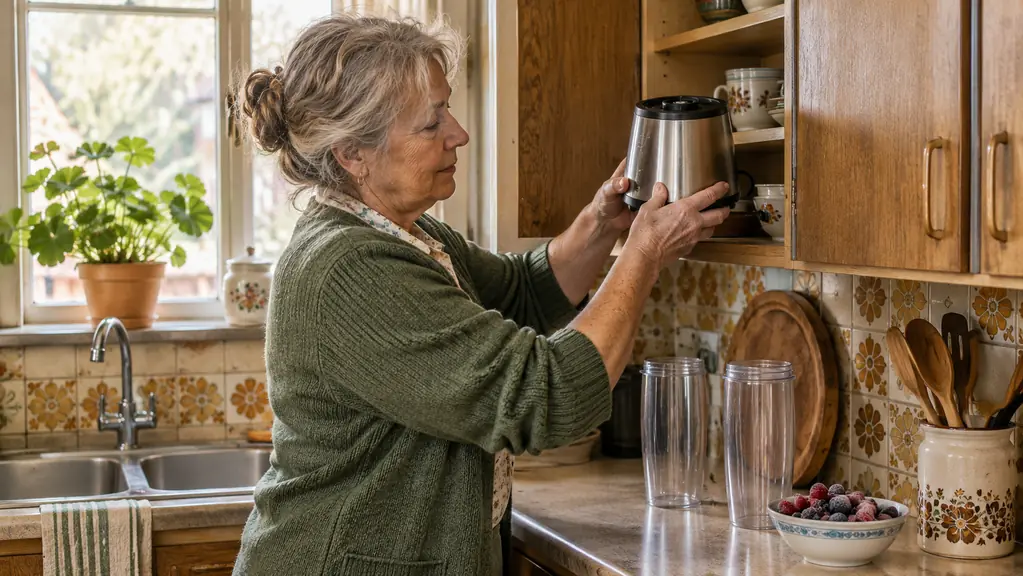
I did not want a blender. Twenty-six years running a school cafeteria taught me that a blender is mostly a thing you wash. Then Gary got into the habit of buying a smoothie on his walk most mornings, and I got tired of watching him pay for something I could make in ninety seconds, so in May I bought the Ninja Fit. Two 16-ounce cups, a 700-watt base, and controls that are pure push to blend: you press the cup down on the base and hold it. It lives in a cupboard, not on the counter, because our kitchen has about eight feet of usable counter and every appliance in this house has to earn its spot.
Here is the short answer before the long one. If you want a real smoothie several mornings a week and there is frozen fruit in your freezer, buy the Ninja Fit. If you want something short enough to leave out on the counter, light enough to move with one hand, and inexpensive enough that you will not feel guilty when it sits unused for a month, the Magic Bullet is the one. My daughter Lisa has had a Magic Bullet for years and I have used it in her kitchen. I have never owned one. Everything I tell you about it comes from her counter and from reading both listings side by side, and I will say plainly which parts of it are better than mine.
| Ninja Fit (QB3001SS) | Magic Bullet | |
|---|---|---|
| Height | 13 inches tall on a 4.3 inch square base, so it needs cupboard clearance | Shorter body that fits under an upper cabinet with a cup on it |
| Motor | 700 watts, which is a lot for a machine this size | A smaller motor, sized for softer ingredients |
| Ice | Ice crush is one of its listed uses and it handles a full cup of cubes | Goes slow on ice and leaves pieces unless you nurse it |
| Cups included | Two 16-ounce cups plus a pour spout, so one is always clean | Cup count and cup size depend on the kit, check the current listing |
| Controls | Press the cup down to blend, let go to stop | Also a press-down design |
| Cleanup | Cup, blade cap and lid into the dishwasher, base gets wiped | Same routine with fewer pieces |
| Noise | Loud enough that you finish your phone call later | Also loud |
| Upfront cost | Costs more | Costs less |
| Best for | Frozen fruit, ice, and two people drinking smoothies most mornings | One soft-ingredient shake at a time in a very small kitchen |
What Six Months of Mornings Actually Looked Like
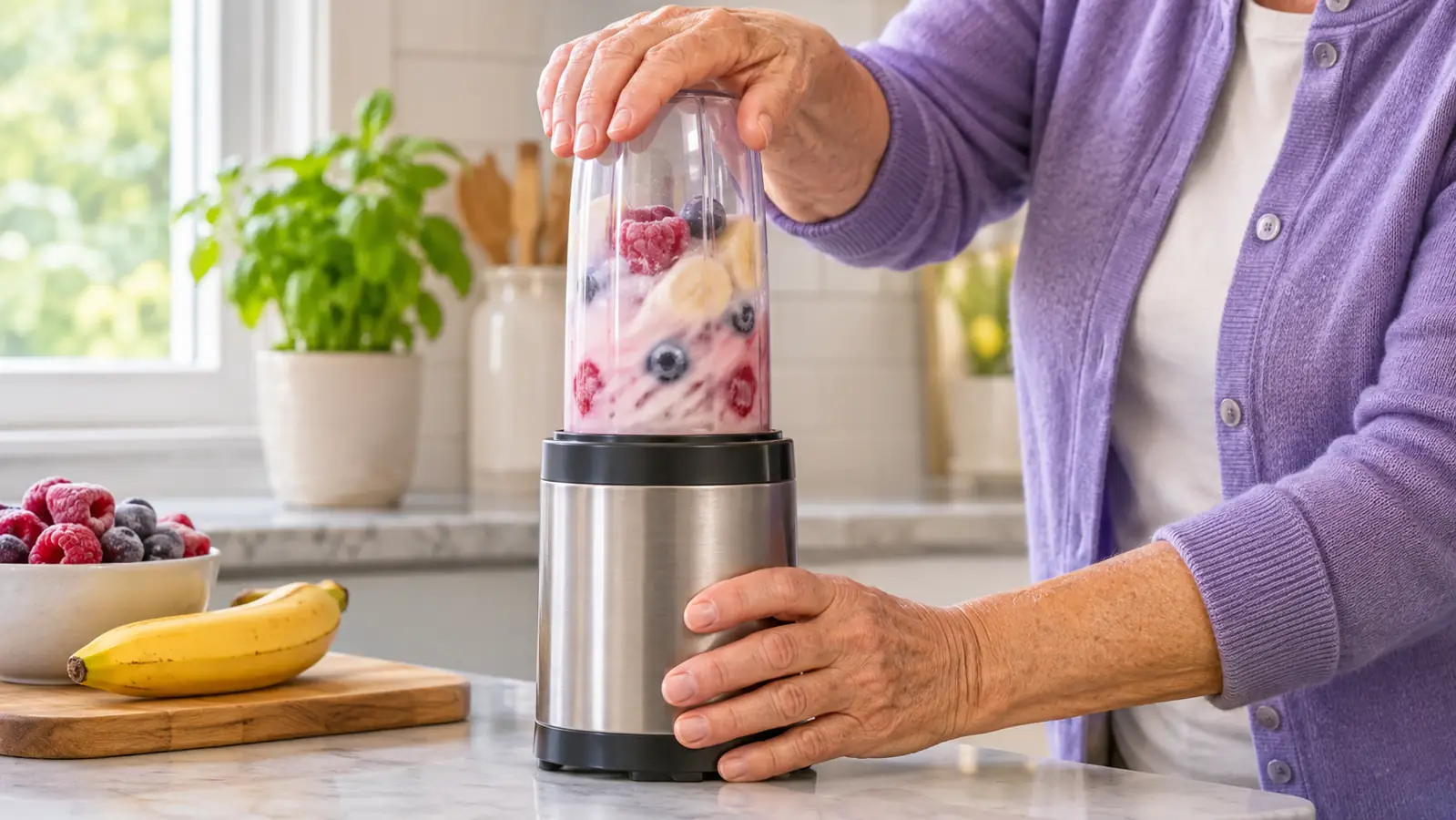
The Ninja Fit comes out of the cupboard most mornings, which is more than I can say for the juicer somebody gave us back in 1998. Gary's smoothie is frozen berries, half a banana, a spoonful of yogurt and a splash of milk. I press the cup down on the base, hold it about twenty-five seconds, let go, and hand it to him with the pour spout lid on. The cup is the glass. That is the entire reason a personal blender exists, and this one does it without my having to think about it at six in the morning.
The motor does not struggle. Frozen strawberries go in whole and come out as liquid, and there are no ice chips left at the bottom to surprise you through a straw. Before this I tried making Gary's smoothie in a mason jar with the hand mixer, which is a thing I am not proud of. It threw yogurt onto the upper cabinet doors and left whole berries bobbing at the rim, and cleaning the wall took longer than making the drink. That experiment lasted two mornings. I have also used the Ninja Fit for salad dressing, for a small batch of pesto in August when the basil took over the garden, and once for a milk shake for the grandkids on a Sunday. It has never walked across the counter while running, which is more than I can say for my hand mixer.
The one thing I want to be straight about is hot liquid. This is a cold-ingredient machine. You blend in bursts by pressing the cup down, and there is no vent for steam. The first week in June I got stubborn and put warm soup in it anyway, on the theory that two short pulses would do no harm. It sprayed tomato across the cupboard door and the blade cap was hot to the touch when I got it off. The machine was fine. My pride was not. Soup goes on the stove, not in this, and the listing does not pretend otherwise.
Cleaning takes a minute. In my house the cup, the blade cap and the lid go in the dishwasher and have held up fine, and the base gets wiped with a damp cloth and put away. Nothing soaks overnight. Nothing has to come apart with a special tool. After twenty-six years of washing industrial everything, I notice these things more than most people do.
Where the Ninja Fit Wins
The motor is the reason I bought this one instead of something smaller. Seven hundred watts, and ice crush is listed as one of its uses right in the product details. I fill a cup with frozen strawberries, a few cubes and a handful of spinach, and it comes out smooth in under thirty seconds with nothing straw-clogging at the bottom. Lisa's Magic Bullet will get there eventually, but you stand over it and nurse it, pressing and releasing, and there are still pieces of ice left when you decide that is good enough. If frozen fruit is your daily habit rather than an occasional thing, that difference is the whole ballgame. The last Sunday in September I made four smoothies back to back, rinsing the two cups between batches, one with frozen mango and ice, one with strawberries, the rest plain banana, and the base never got warm and never needed a rest. The counter was wiped down before the pancakes hit the griddle.
The second thing is that you get two cups. One is clean while the other is in the dishwasher, and that sounds like a small thing until you have made a smoothie four mornings running and had to wash the same cup by hand every time. They hold 16 ounces each, they are BPA free, and the kit includes a pour spout, so a cup can go straight into the refrigerator or into a lunch bag without a transfer. It also carries a one year limited warranty, which is not generous, but it is stated plainly and I like that better than a vague promise.
The Ninja Fit is 13 inches tall before you put a cup on it. That single number is why mine lives in a cupboard and Lisa's Magic Bullet lives on her counter.
Where the Magic Bullet Wins
Here is where Lisa's machine beats mine, and it is not close. It is short. It sits on her counter under the upper cabinet with the cup on it and nothing has to move out of the way. Mine is 13 inches tall before a cup goes on top, so on my counter it does not fit under the cabinet, and into the cupboard it goes. If you have ever owned a small appliance that lived in a cupboard, you know exactly what that costs you. Out of sight is out of mind, and the thing you leave out is the thing you actually use. Lisa keeps hers beside her sink with a cup on it and the cord tucked behind the toaster, and I have watched her make a shake there without moving the machine an inch in any direction. Mine means reaching into a cupboard above my head, which at sixty-four is not nothing, especially on a morning when my shoulder is stiff.
It also costs less, and for plenty of people that is the whole question, which is fair. The smaller motor is a reasonable trade for someone who makes one soft shake, milk and banana and a scoop of protein powder, and never asks it to crush ice. It is lighter, it takes less room on a shelf, and you can move it with two fingers. If your honest answer to how often you will use it is twice a week and never with frozen anything, the Magic Bullet does the job for less and I would not talk you out of it.
If the Fruit Goes In Frozen, This Is the Base That Gets Through It
The Ninja Fit is the one I bought with my own money in May, and it still comes out of the cupboard most mornings. 700 watts, two 16-ounce cups, a pour spout and push-to-blend controls with no dial to fiddle with. Twenty-five seconds and the cup is the glass.
Amazon Check Today's Price on Amazon →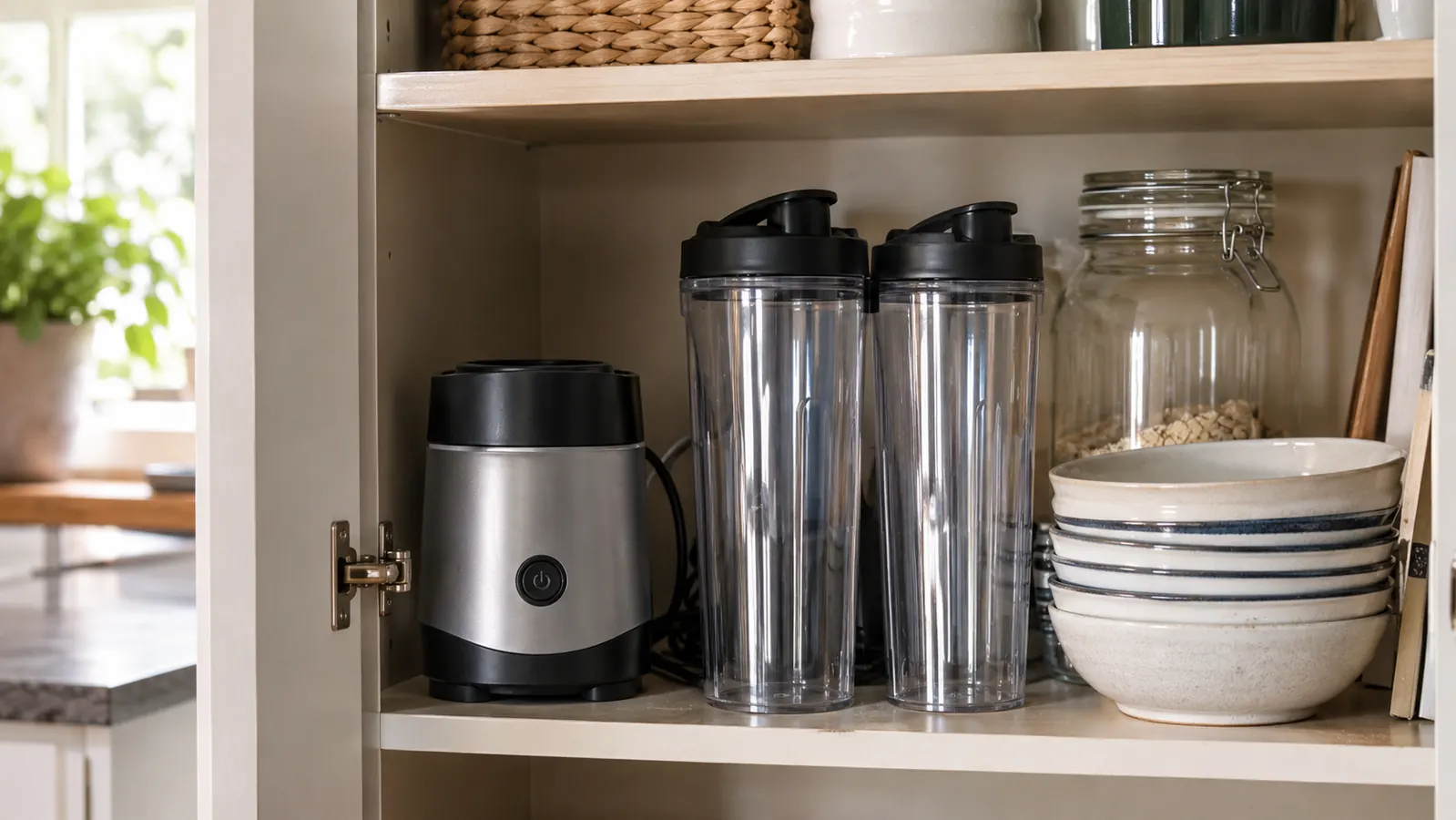
Counter Space, Which Is the Real Question
Our kitchen has about eight feet of usable counter and one sink, and that counter is already hosting the coffee maker, the toaster and the air fryer. That is before anything else asks for room. So when a new appliance arrives in this house, the first question is not how well it blends. It is where it lives, and whether taking it out is a two-second reach or a decision.
The Ninja Fit base measures 4.3 inches deep by 4.3 inches wide by 13 inches tall, and it weighs 3.1 pounds. That footprint is tiny. The height is not. I measured the clearance under my upper cabinets with a tape the week it arrived, from the cabinet bottom down to the counter, and got a hair under fifteen inches to the first shelf bracket. Thirteen for the base plus a cup on top puts it over that, so that settled it. Thirty seconds with a tape measure saved me a year of sliding things around. With a cup on top there is no way it slides under my upper cabinets, so the cupboard is the only other option, and that is where it has been since May. It is not a burden, because the cupboard is two feet away. But if you were picturing it sitting next to the coffee maker like the pictures on the box, measure your clearance first.
The counter conversation is about habit more than inches. A blender left out gets used because there is no step between wanting a smoothie and making one. A blender in a cupboard gets used if you are the kind of person who has already built the habit. I am. Not everyone is. If this is your first personal blender, be honest with yourself about which person you are before you decide that a shorter machine is worth the sacrifice in power, or that the power is worth the trip to the cupboard.
Who Should Buy Which
Buy the Ninja Fit if you make smoothies most mornings, if frozen fruit or ice is going in the cup, if two people in the house drink them, and if you have a cupboard or a pantry shelf where a 13-inch appliance can live without being in your way. Buy it if you want the cup to be the glass you drink from, and if you like the idea of a second cup sitting clean while the first one waits for the dishwasher. That is the machine I bought and the one I would buy again.
Buy the Magic Bullet if you make one drink at a time, if ice never goes in it, if you want the thing to stay out on the counter where you can see it, and if the difference in cost matters more to you than the difference in power. It is also the better gift if you are buying a first blender for someone and you are not sure the habit will stick. Less money sitting unused in a cupboard is easier to live with than more.
The Two Questions I Get Asked
Why not just buy a full-size blender? For two people, a big jar is a lot of washing for one drink, and it eats counter space I do not have. The whole advantage of a personal blender is that the cup you blend in is the cup you drink from and the cup you wash. One vessel, start to finish. A full-size jar means pouring into something else and then washing both.
And is 16 ounces enough? For one adult smoothie, yes, with a little room to spare. For two people you make two cups, which is exactly what the second cup is for. If you are blending a batch to freeze or feed a Sunday crowd, neither of these machines is the right tool and you already know that. These are for the everyday glass, not the production run.
The Cup You Blend In Is the Cup You Wash
Two cups means one is always clean, and that is the difference between a blender you use and a blender you resent. Six months in, mine still earns the trip out of the cupboard several mornings a week.
Amazon Check Today's Price on Amazon →