
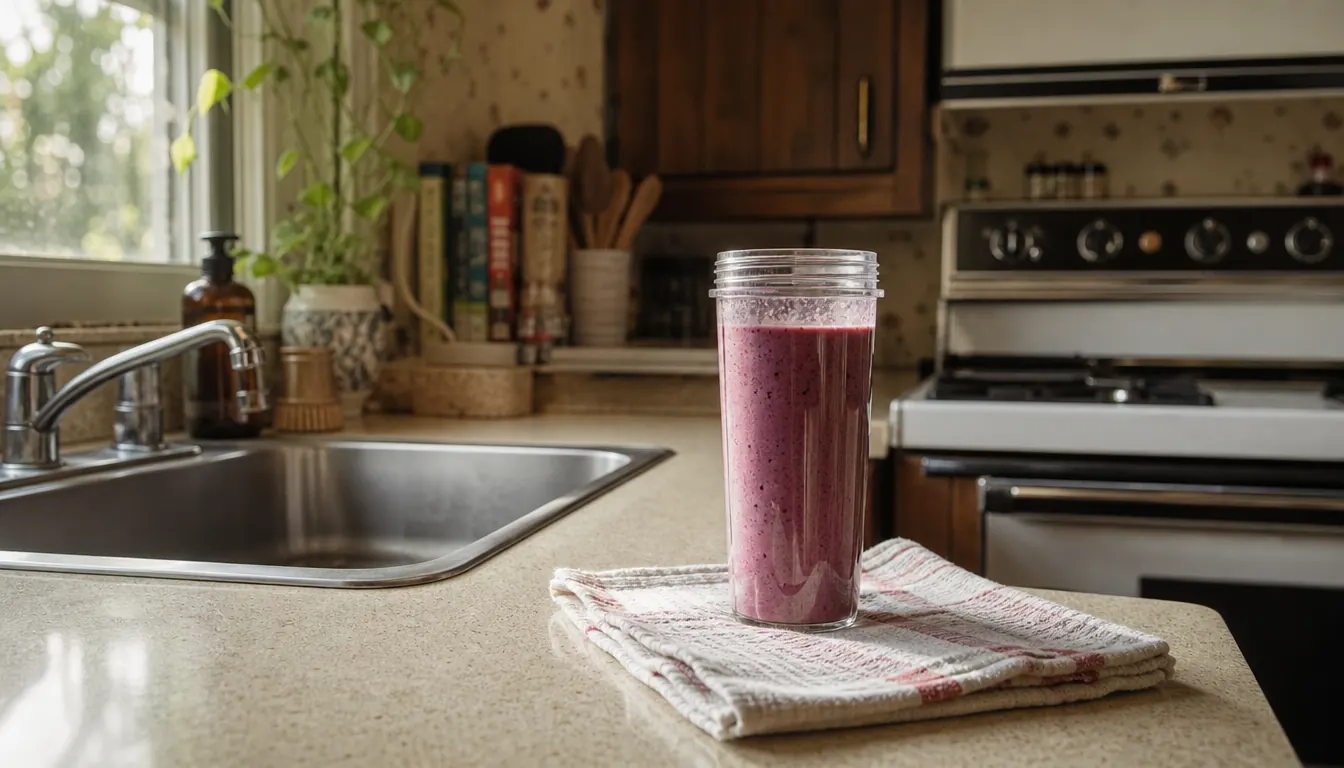
I bought the Ninja Fit this past May, mostly so my husband Gary could have a fruit smoothie in the morning without me hauling out a big pitcher, washing it, and finding a place for it to dry. That was the whole reason. Our kitchen has about eight feet of usable counter, a single sink, and one cupboard that has to hold everything not used daily. Another appliance-sized object was not obviously going to earn its spot.
Six months and a few hundred smoothies later, here is the part that surprised me. Almost none of the mess has been the machine's fault. The bad mornings are the ones where I overfilled the cup, or set it down on the counter with a wet bottom and left a ring, or leaned on it too long and ended up with something closer to slush than a smoothie. The Ninja Fit has not thrown anything at me that I did not hand it first. It makes exactly the mess you give it. What follows is the routine I use now, most mornings, standing at the cupboard between the mixing bowls and the rice.
The cupboard blender I reach for five mornings a week
700 watts, two 16-ounce cups, and a base you press the cup down onto. It weighs about three pounds, so it comes out of the cupboard with one hand.
Amazon Check today's price on Amazon →Step 1: Load the cup bottom-heavy
The order you put things in matters more than anything else you will do. Liquid goes in first, at the bottom of the cup. In my kitchen that is about a third of a cup of milk, or a spoonful of plain yogurt loosened with a little water. Then the soft fruit. Then the frozen fruit and the ice, last, sitting on top of everything else. That is not fussiness. It is the difference between a smoothie and a cup of frozen strawberries going around in circles. The Ninja Fit will do its part either way. It cannot do the part that happens before you press down.
The first week, before I had the habit, I put the frozen berries in first and poured the milk over the top. The milk ran down the sides, the berries sat in a lump, and what I got after a minute of pressing was a cold cup with whole berries rattling around inside it. When the wet things sit closest to the bottom and the frozen things sit on top, the frozen pieces get dragged down into the liquid instead of spinning above it. Same fruit, same machine, completely different result.
My standard cup now is half a banana, a small handful of frozen berries, one spoon of yogurt, and milk to just below the one-third mark, which fills the cup about two thirds of the way once the fruit is in. There is nothing precise about it. The order is the part that matters.
One thing I had to unlearn from the cafeteria: volume. For twenty-six years I made fruit cups for a few hundred kids at a time, and my hands still want to fill a container to the top because a full container is a finished job. That instinct is exactly backwards here. A half-full cup blends in twenty seconds. A full cup makes you stand there pressing and shaking and getting nowhere, and then it either leaks or you give up and drink something lumpy. If you take one thing off the counter from this article, take the idea that the cup being partly empty is the machine working properly, not you being shortchanged.
Step 2: Leave room at the top
The Ninja Fit cup is 16 ounces, which makes one good-size smoothie and leaves very little margin for error. My worst morning involved filling it right up to the rim because the fruit looked like it would fit. It fit. Then the cup went onto the base, and about ten seconds in, something gave, and I spent a while wiping the counter and the top of the motor base while the rest of breakfast waited.
Now I stop with about an inch and a half of clear space below the rim, and I have not had a repeat. Frozen fruit breaks apart and takes up more room than it did as solid chunks, and the cup needs somewhere for that to expand into. An overfilled cup does not just leak. It also blends worse, because the whole thing turns into one dense plug that the blades cannot pull down through.
If you have a bigger appetite than the cup does, the answer is a second cup, not a fuller first one. There are two 16-ounce cups in the box, so two people can each have one without washing in between.
I measured the headroom once, with a ruler, because after the puddle I wanted a number I could trust instead of a feeling. An inch and a half below the rim, measured with the fruit already in and settled. Sitting on the counter it is 13 inches tall and the base footprint is a touch over four inches square, so it stands in a small patch. Fill line settled, the cup holds comfortably under two thirds of its stated capacity in actual blended smoothie. If you are feeding a teenager, that is one serving. If it is you and a husband who eats toast with his, it is two small ones, and the second cup handles that without any change to the routine.
Step 3: Press and let go
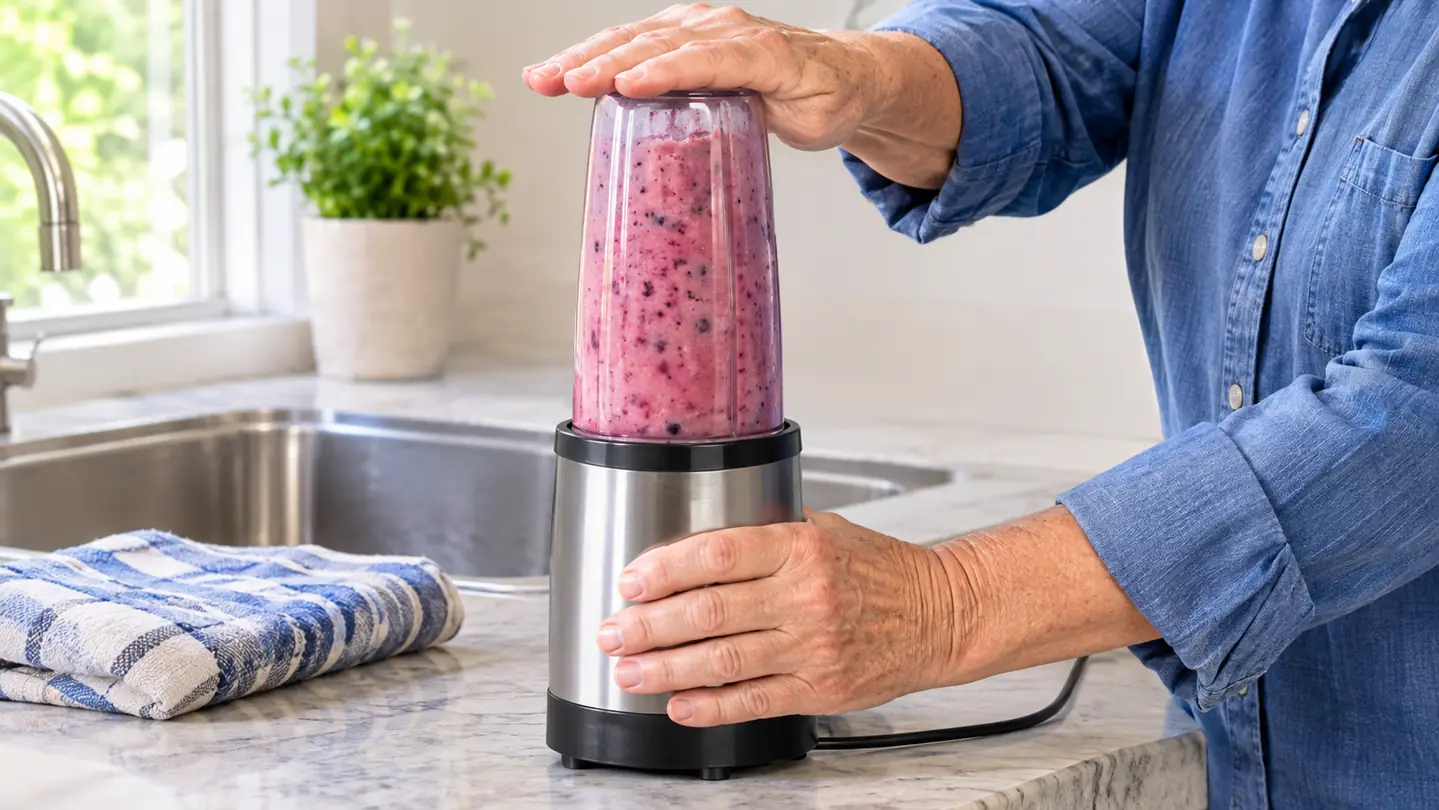
This is the one that took me the longest to learn. The Ninja Fit is push-to-blend. There is no button to hold, the cup itself is the switch, and the motor runs while you press the cup down onto the base. My instinct for the first several weeks was to lean on it: hold the cup down and keep holding until the noise changes. That is exactly wrong, at least with frozen fruit.
Short presses work better. Five or six of them, each a second or two, with a pause in between. The pause is the whole trick, because it lets the fruit fall back down onto the blades instead of hanging above them in a pocket of air. With a frozen banana and berries I press five or six times, lift the cup, shake it once, set it back on and press five or six more. Two rounds and it is done.
The 700 watts is plenty for what I ask of it. Frozen berries, ice cubes, a frozen banana cut into rounds. It has never bogged down and I have never had to stop and help it along with a spoon. The only time it struggles is a cup packed too full of frozen fruit with no liquid to move things around, which is not the machine's fault, and is fixed by reading step one again.
A concrete example, because this is the sort of thing that only makes sense after you have felt it. One morning in June I decided to skip the pause and just hold the cup down for a full minute, the way you would with a big countertop machine. At forty-five seconds the smoothie had gone from chunky to a thick paste that had climbed the inside of the cup and stopped moving. The blades were spinning in a pocket of air underneath it. I took the cup off, shook it hard, put it back, and three short presses finished it in about eight seconds. Same ingredients, forty seconds of my morning saved, and I have not held it down since. If the sound goes flat and stays flat, that is the sign to lift and shake, not to press harder.
Six months, five mornings most weeks, one real puddle. The machine did not make it. I did, by filling the cup past the point where the fruit had room to move.
Step 4: Give it somewhere to land
Almost every drip in my kitchen happens in the four seconds after the cup comes off the base. The bottom of the cup is wet, the counter is close, and if I set it straight down I get a ring. Then I pick it up and the ring goes onto whatever I set it on next.
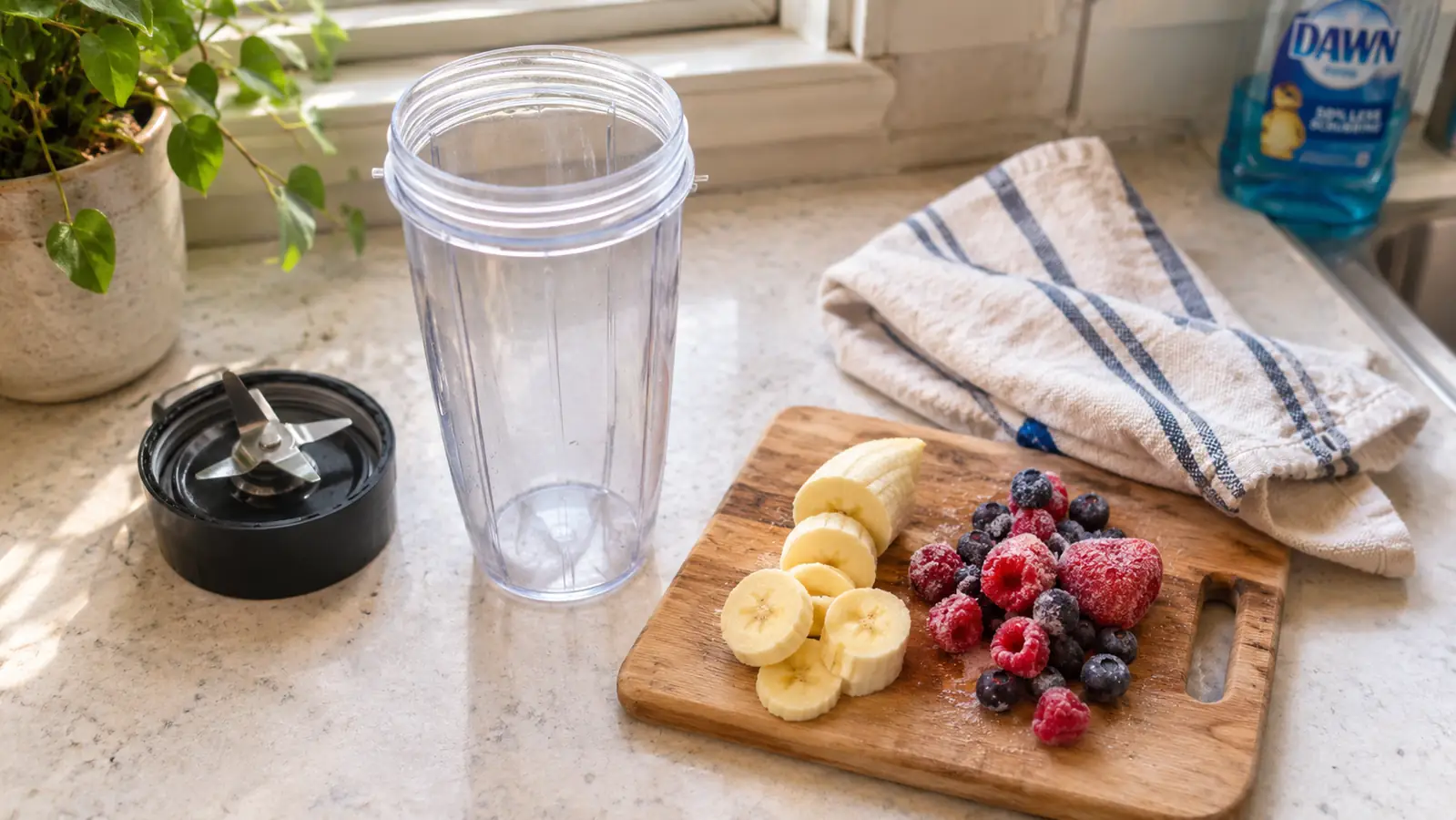
I keep a folded dish towel on the counter in the spot where I blend, and the cup goes straight onto that. Not a paper towel, which slides out from under it. A folded towel catches the drip and stays put. It sounds like a small thing. It is the single change that took me from two or three wipe-downs a week to about one.
The towel is not doing anything clever. It is just there, in the same twelve inches every time, so my hand has somewhere to go that is not the bare counter. When I blended at the other end of the kitchen for a week while the sink was occupied, I was back to wiping every morning. Location beats technique.
Once the cup is down, the lid goes on and the smoothie is done. There is a pour spout in the box, and if you want to pour this into a glass, that is what it is for. I skipped the glass. The cup you blend in is the cup you drink from, and one less dish to wash is most of the reason to own a small blender in the first place.
Step 5: Rinse it before you sit down
The difference between a personal blender that gets used and one that ends up at the back of a cupboard is about ninety seconds of washing. Leave a smoothie sitting in the cup until after breakfast and you will come back to something that needs a soak and a brush. Rinse it while the coffee is still brewing and it is nothing at all.
My routine: fill the Ninja Fit cup about a third of the way with warm water and a drop of dish soap, press it back onto the base for a few seconds, dump it, then rinse the cup and the lid under the tap and wipe the top of the base with a damp cloth. That is it. I wash it by hand because it takes less time than loading a dishwasher and I do not want to give up the counter space. Gary does the dishes most nights, but this one I do as I go, because it is not a job, it is a rinse.
The towel under the cup does a second job here: it is where the wet cup and lid sit while I put the base away. Without it, the wet parts end up in the dish rack and then on the counter, and I find cold water on the counter an hour later. Small mechanics, but they are the whole difference between this being a habit and this being a thing you stop doing by the end of the summer.
One note on what not to put in it: hot things. This is a cold blender. I have never put soup or hot liquid in mine, and I would not. Hot liquid in a sealed cup that you then press down onto a base is not a problem I want in my kitchen at seven in the morning, and it is not what the machine was built for.
What Else Helps
Prep on Sunday. I cut bananas into rounds and freeze them on a tray, then bag them, and I do the same with berries that are about to go soft. A few minutes of prep on Sunday means weekday mornings are dump and press, not chop and press. The mornings I skip the prep are the mornings I skip the smoothie.
Store it where you can reach it. The Ninja Fit lives in a cupboard at shoulder height, not on the floor of the pantry, and it weighs about three pounds, so getting it out is one hand and no bending. An appliance you have to squat for is an appliance you stop using by February.
Give it a fixed spot on the counter, too, even if the machine itself lives in the cupboard. Mine is about a twelve-inch square of counter next to the sink, with the towel already folded there. Everything happens inside that square, so the mess never gets further than that. When I let the cup wander to the other end of the kitchen, I find a ring there the next day.
Keep the extra cup in the same cupboard, upside down, so it is dry when the second person wants one. I learned that the untidy way. The first month the second cup sat on the counter with a little water in the bottom, and by the time Gary wanted a smoothie too, it needed a wash before it could be used.
If someone in the house wants kale in theirs, do not put the kale in first. It is light, it floats, and it wraps itself around the top of the cup. Put it in the middle, under the frozen fruit, and it gets pulled down with everything else.
And it is not quiet. None of these small machines are, and this one has a high whirring note that carries through the house. Gary can hear it from the bedroom. Six months in I have stopped noticing, but if you blend before anyone else is awake, that is worth knowing before you buy.
Six months of smoothies, one small base, no pitcher to wash
Two 16-ounce cups, push-to-blend, and a rinse that takes under two minutes. My Ninja has lived in the cupboard since May and it is not going anywhere.
Amazon See the Ninja Fit on Amazon →