
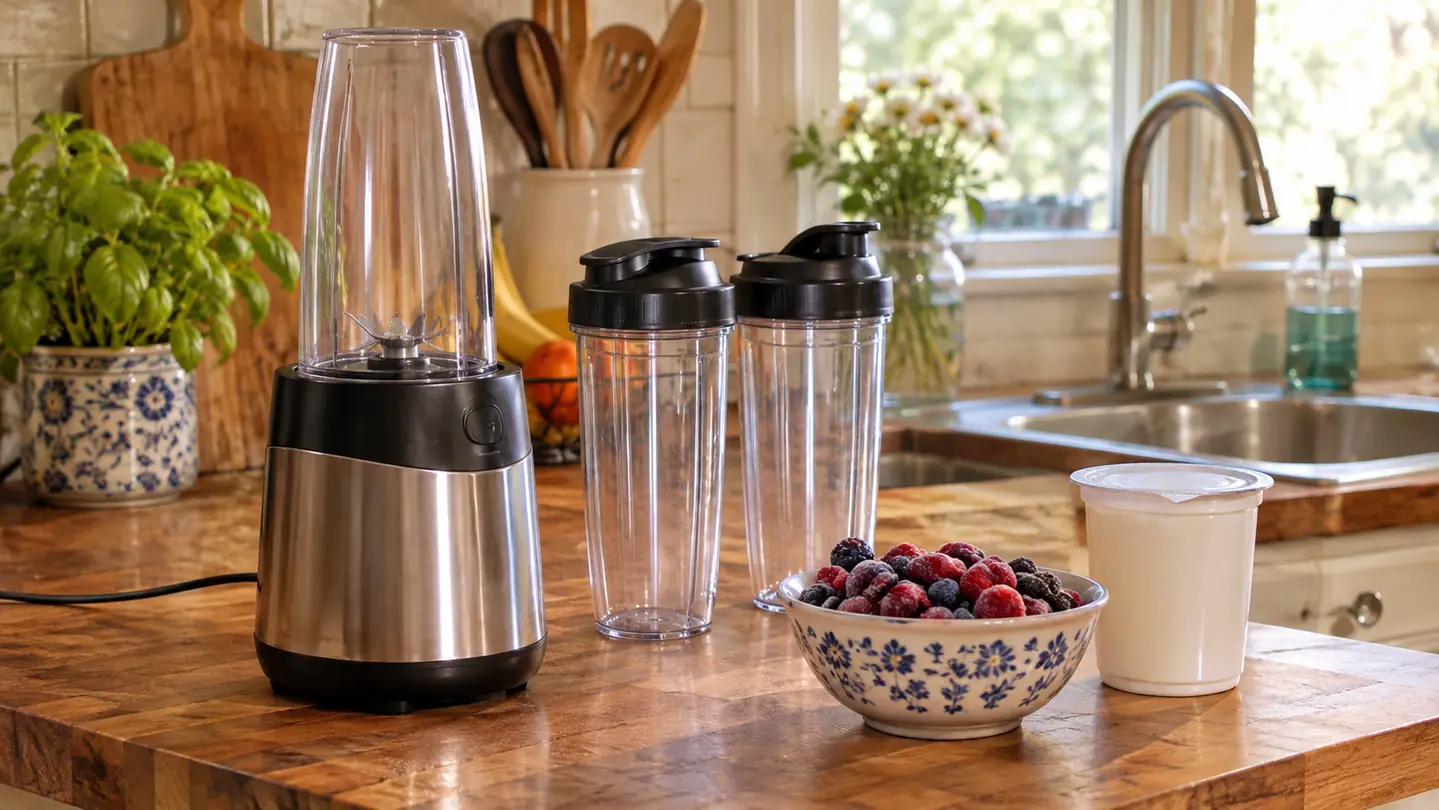
Nobody warns you that a personal blender has a big voice for such a small footprint. I bought the Ninja Fit this past May after several years of owning no blender at all. The first morning I made Gary a smoothie, he came out of the back bedroom and asked what I had dropped on the floor.
Nothing had dropped. That was 700 watts doing its job inside a plastic cup. I spent twenty-six years running a school cafeteria kitchen, so I am not easily impressed by a motor, and I am not easily impressed by a gadget that wants its own shelf. What follows is the honest version: what this machine does well, what it does badly, and the two or three things I wish somebody had mentioned before I ordered it.
The Quick Verdict
Small, quick and genuinely easy to rinse out. It is loud, it only handles cold ingredients, and the cups are plastic, but six months in I still reach for it several mornings a week.
Amazon Check Today's Price →Loud, small, and back in the cupboard by seven in the morning
Two 16-ounce cups, one base, no learning curve. It has earned its shelf in a kitchen where nothing gets a shelf for free.
Amazon Check Today's Price on Amazon →How I Have Used It Since May
Our kitchen has about eight feet of usable counter and a single sink, so anything that lives out has to be used almost daily. The Ninja Fit does not live out. It sits in the cupboard above the toaster, which sounds like a demotion and is not. It comes down several mornings a week, and it goes back up because it fits on a shelf without me moving anything else out of the way first.
Mornings, it is a fruit smoothie for Gary. Frozen berries, half a banana, plain yogurt, a splash of milk. He drinks it standing at the sink and then heads out for his walk. Beyond that it is salad dressing, which it handles better than any whisk I own, and pesto in the summer when the basil gets away from me. That is the honest list. No soup, no nut butter, no grinding grain.
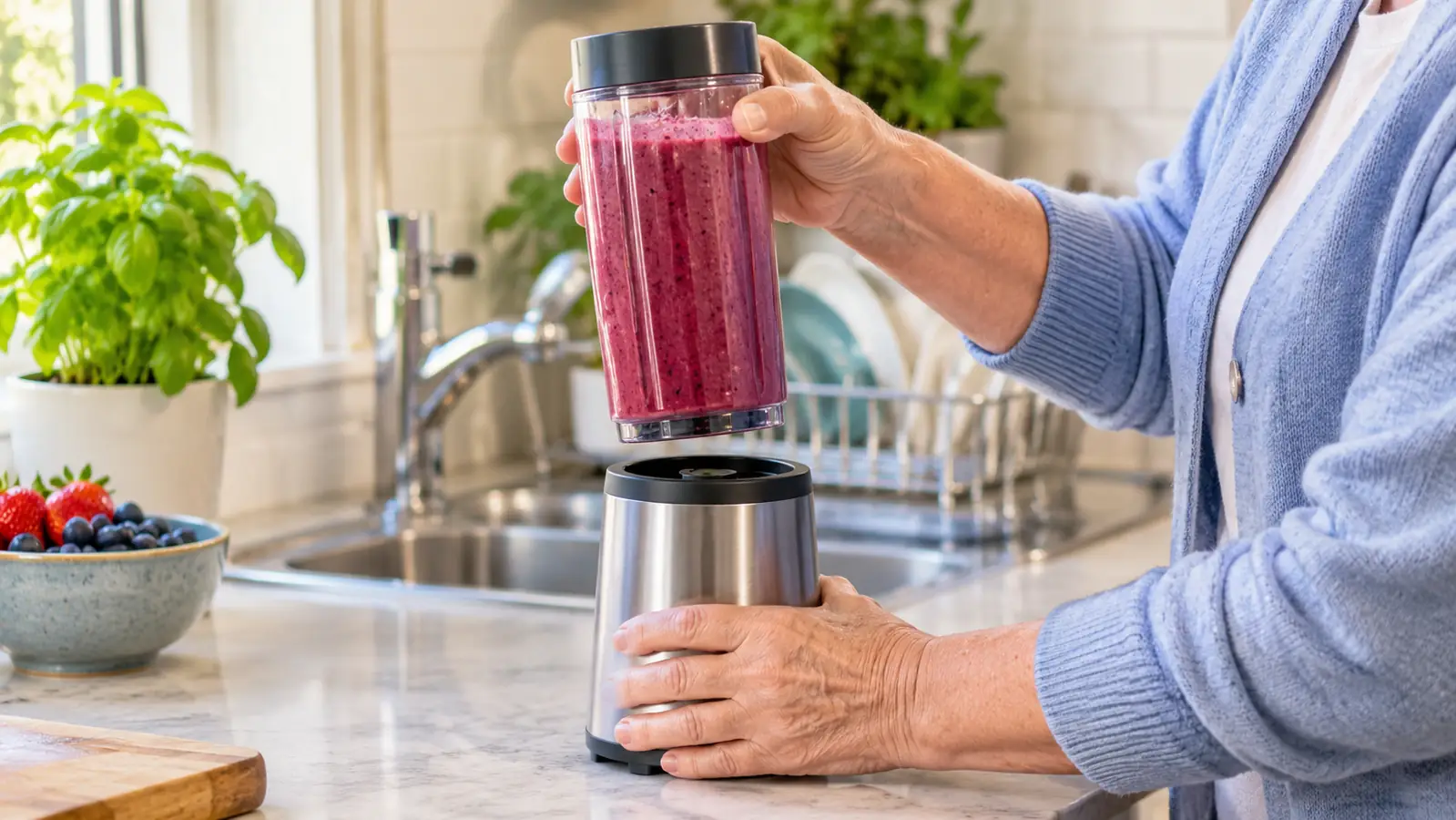
The way it runs is simple enough that I did not need the booklet. You put the ingredients in one of the two 16-ounce cups, set the cup on the base, and press down. Let up and it stops. There is no dial, no speed to choose, no program to scroll through, which I consider a feature at my age and would have considered a limitation at forty. If you like settings, this will feel stripped down.
The First Thing Nobody Tells You Is the Noise
Every review mentions that it is loud. None of them prepared me for how loud. It is not a hum or a whine. It is closer to a small engine, and it does it right at counter height, about two feet from your ear. The first week I flinched every time I pressed the cup down. Now I start it and step back, which is not a technique anybody taught me, it is just self-preservation.
This matters more than the spec sheet suggests, because a personal blender runs in short bursts. Ten or fifteen seconds and you are done. You are not standing next to a jet engine for five minutes. But if you have a grandchild napping on the other side of a wall, or a husband who reads in the next room, this is the detail you will notice first and complain about longest. It is also the reason the machine stays in the cupboard and not on the counter.
I would not call it a deal breaker. I would call it the thing that decides whether the machine stays out or ends up behind a cabinet door, and in my case it is half the reason it lives on a shelf. The other half is counter space, which we will get to. If quiet matters more to you than speed and cleanup, this is not your blender and no amount of reading reviews will change that.
Two 16-ounce cups, one base and a footprint of about four inches square. The whole machine takes up less room than my toaster.
The Press-Down Base Does Exactly One Thing
The control is your hand. You press the cup onto the base and it runs. You lift and it stops. That is the entire interface. There is nothing to hold down, no lock to engage, nothing to scrub around. After twenty-six years of cafeteria equipment with panels full of settings nobody used, I found this refreshing rather than limiting. Gary figured it out without being told, which is its own kind of endorsement.
The trade is that you have to stand there. You cannot load a cup and go get dressed while it works. For smoothies that is fine, because you are finished in seconds. For anything thicker, you are committing to standing at the counter with your hand on a cup. This is a machine you operate, not a machine you supervise from across the room, and if that bothers you, buy a jar blender with a lid and a switch.
I also learned to press in short pulses rather than one long push, especially with frozen berries. Long pushes warm the mixture and can leave a chunk of frozen banana stuck against the side of the cup. Short taps, lift, shake the cup, press again. Three or four rounds and it is smooth. The booklet mentions pulse; my hand figured it out first. A whole bag of frozen strawberries will not come out perfectly smooth in one go, and expecting it to is how people end up disappointed.
Cleanup Is Why It Keeps Coming Back Out
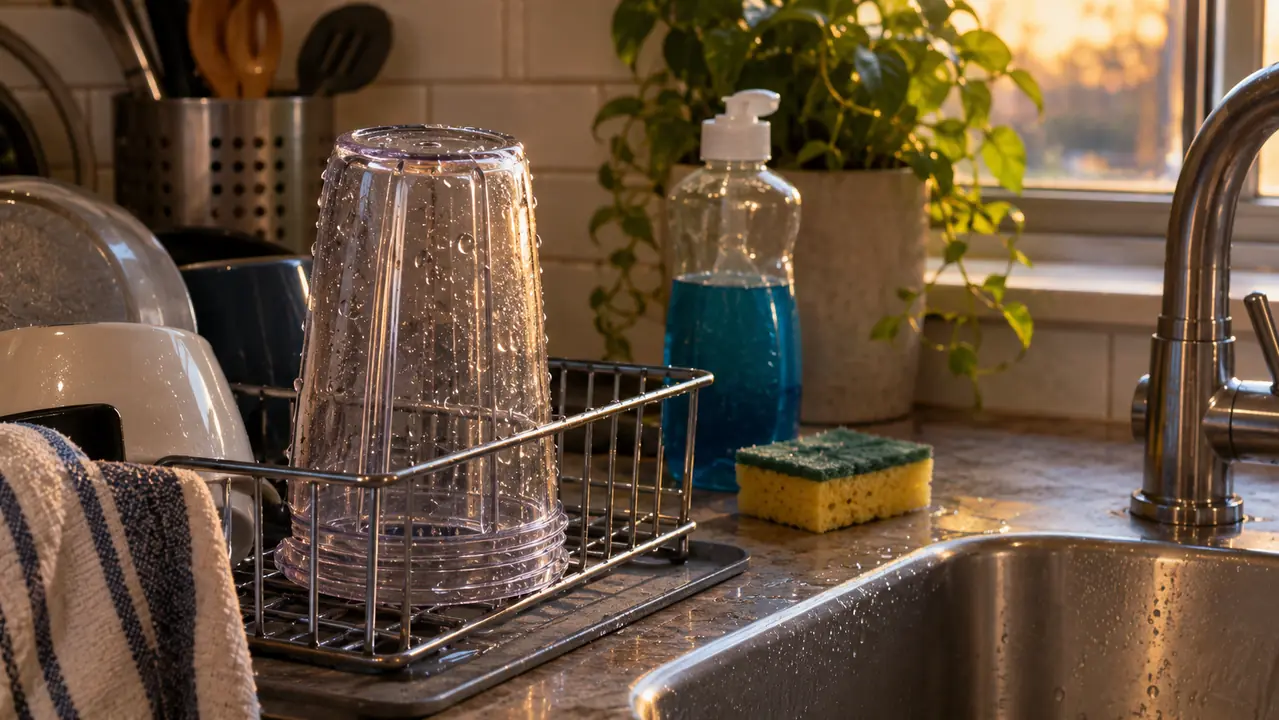
Here is the part that surprised me most, and it is the reason I still use it. Cleanup takes less than a minute. Rinse the cup, add a drop of dish soap and warm water, press it onto the base for a few seconds, rinse again, set it in the rack. I run the cups through the dishwasher too, top rack, and they have held up without clouding. Gary does the dishes most nights and he has never once complained about it.
That sounds small. It is not small. The reason appliances die in my house is not that they break, it is that they become a chore. A blender you dread washing stops getting used by the second week, and then it lives in the basement next to the bread machine. I cannot compare it to other blenders because I have never owned a different one, but I can tell you the short wash is the difference between a machine in a cupboard and a machine in a box.
Cold Ingredients Only, and I Mean That
The manual is clear that it is for cold things, and this is where a personal blender differs from the jar blender your mother had. Do not put hot soup in it. Do not pour in something straight off the stove and expect to be fine. The cups are plastic and the seal is plastic, and heat plus plastic plus a sealed cup is a bad combination no matter whose name is on the front. I have not tested that and I do not intend to.
The spec sheet lists ice crush and juice among the recommended uses, and I have crushed ice for Gary's smoothies without trouble, though I would not try to make a whole cup of shaved ice. For dressing, the order matters. Liquids first, then the mustard and vinegar, then the oil, and it comes together in a few seconds. When I did it the other way around it separated by dinnertime. Small thing, worth knowing.
The One I Compared It To
My daughter Lisa has a Magic Bullet, and I have used it in her kitchen enough times to have an opinion. Hers is smaller and it makes a smaller cup of smoothie, which suits her and does not suit Gary, who drinks his in about four swallows and would happily take a second. Neither machine is fancy. Both are plastic, both press down, both wash in under a minute. The Ninja Fit won for me because of the two 16-ounce cups, which means I can make his and leave mine in the fridge for later.
If you are deciding between the two, I would not overthink it. Pick the one whose cups match the amount you actually drink. What I would not do is buy either one expecting it to replace a jar blender, because it will not, and the person who tells you otherwise has not tried to puree a pot of soup in a cup the size of a drinking glass.
Six Months In, What Has Held Up
The base is 3.1 pounds and measures about 4.3 inches square by 13 inches tall, which is roughly the footprint of a coffee mug and the height of a cereal box. Nothing has loosened. The cups have been through the dishwasher repeatedly and the markings are still legible, which is more than I can say for a set of measuring cups I own. The lid seals are still snug enough that I do not worry about a smoothie landing on my shoes.
The warranty is one year, limited, which is ordinary for the category and worth noting if you are the sort of person who registers things. I did not. My one long-term worry is the plastic itself, since plastic eventually hazes and holds onto smells, but six months in the cups look the way they did the week I unboxed them. The recipe guide that came with it is fine and I have used it twice. Mostly I make the same two things and I am happy with that.
What I Liked
- Tiny footprint at about 4.3 inches square, so it fits a cupboard shelf without rearranging anything
- Cleanup in under a minute, and my cups have survived the dishwasher without clouding
- Push-to-blend means no dials, no programs and nothing to learn
- 700 watts powers through frozen berries and ice for a daily smoothie
- Comes with two 16-ounce cups, a pour spout and a recipe guide
Where It Falls Short
- Genuinely loud, and it runs at ear height on the counter
- Cold ingredients only, so no hot soup and nothing off the stove
- You have to stand there and hold the cup down the whole time
- Plastic cups will not stay clear forever
- No way to load it and walk away while it works
What It Will Not Do
It will not replace a full-size blender, and it is not built to. There is no batch cooking here. Two 16-ounce cups is the entire capacity, and one cup is one serving. For Sunday dinner with the grandkids I am not blending anything at scale, I am using a whisk and a bowl and my own arm. If you want to puree a pot of soup or make pesto by the pint for the freezer, this is the wrong machine and no technique will fix that.
It also will not handle anything thick and stiff for long. Nut butter, heavy dough, a big batch of hummus, those are jobs where a small motor works hard and the mixture climbs the walls of the cup. I have not tried any of them. I read the manual, I know what the machine is for, and I would rather have a blender that does smoothies well for years than one that does everything badly for eight months. That is a lesson I learned the expensive way with other appliances.
About That Counter Space
Every appliance in my kitchen has to justify itself because there is not much room to give. The Ninja Fit was easy to justify for a reason I did not expect: it does not need to live out. A blender parked on the counter would cost me the spot where I chop, and I chop every night. So it lives in the cupboard and comes down when needed. At 3.1 pounds with a small square base, putting it away is a two-second job with nothing to reassemble and nothing to line up.
If you have a big kitchen and counter to spare, leave it out. It will get used more often, and there is nothing wrong with that. But if your counter is tight like mine, know that this is one of the few small appliances that genuinely tolerates being put away, and that is a real part of why I still like it after six months of use.
Who This Is For
This is for someone making one or two servings at a time. A smoothie in the morning, a dressing at dinner, pesto when the basil is ready all at once. It is for a small kitchen where the machine goes back in a cupboard, and for a person who would rather press a cup than learn a control panel. It is also for someone who does not mind noise for fifteen seconds. If you need to hear your own thoughts while blending, look elsewhere, because you will not.
Who Should Skip It
Skip it if you need to blend hot liquid, if you routinely cook for a crowd, or if the noise would be a genuine problem in your house. Skip it if you want a machine you can load and walk away from, or if you are expecting it to do the work of a jar blender. And skip it if plastic cups bother you. Nobody puts that in the listing, but it is the honest answer: this is a plastic machine, built to a plastic machine's standard, and it will not feel like anything else.
Six months of mornings later, still out of the cupboard and back in
If you want one cup, one press and a rinse under the tap, this does the job. Loudly, and only with cold ingredients, but it does the job.
Amazon Check Today's Price on Amazon →